Your birthday cake candles don’t tell your whole story. While years go by, your body takes its own path. Biological reality often doesn’t match simple math, creating a gap between how old you feel and your real age.
Modern longevity science is moving toward precise, data-driven assessments. By 2025, advanced digital tools will be widely available to track your internal state. These tools give you a clearer view of your wellness than ever before.
You now have the power to track your vitality with high accuracy. Using these new technologies helps you improve your daily habits for a better future. Proactive health management changes how you experience every stage of life.
Understanding the Science of Biological Aging
Your birthday shows how many years you’ve lived, but it doesn’t tell the whole story of your health. People often use a calendar to measure their life, but this number doesn’t show how well they’re doing.
Looking at your cells can reveal how your body really works compared to others. This new way of thinking is key for anyone wanting to stay healthy for a long time.
Chronological Age vs. Biological Age
Your chronological age is just how long you’ve been alive. It keeps going up, no matter what you do.
Your biological age shows how well your body is working. It’s like the age when most people are in the same health state as you.
Essentially, you might look forty but feel like thirty or fifty. Knowing this lets you take steps to improve your health.
The Role of Biomarkers in Aging Research
Scientists use biomarkers to figure out these differences. These are signs of your health, like DNA changes or blood proteins.
Think of biomarkers as your body’s vital signs. They help researchers see how fast or slow you’re aging.
With these tools, you can see how your body is doing inside. This knowledge helps you make choices for a healthier life.
The AI Aging Clock: Can It Measure Healthspan?
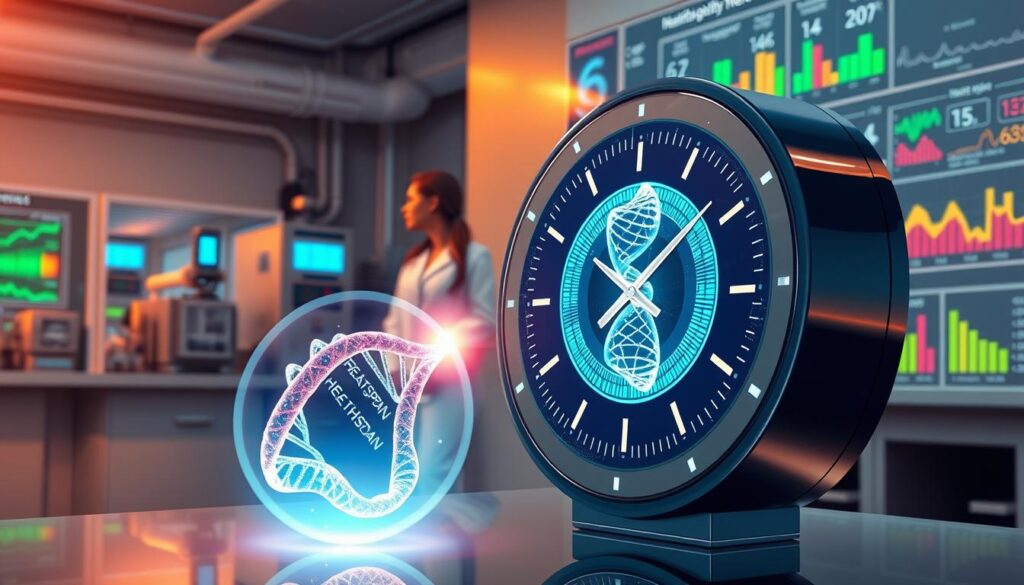
Modern science is now more interested in how well we live than just how long. Traditional medicine looks at your age, but new tools offer a deeper look at your health. The AI Aging Clock: Can It Measure Healthspan? This question is key to a new era in personalized medicine.
How Machine Learning Models Analyze Biological Data
Machine learning algorithms look at lots of complex biological data. They scan your blood markers, genetic expression, and cellular activity. This helps create a picture of your current health.

This data-driven approach lets researchers see how lifestyle choices affect your body. These systems get better with more data. Clinics can now offer insights that were once impossible.
Distinguishing Between Lifespan and Healthspan
It’s important to know the difference between living longer and living well. Lifespan is about how many years you live. Healthspan is about how many years you live in good health. These tools aim to increase your healthspan so you can stay healthy longer.
By looking at your biological markers, these models spot risks early. This is key for anyone wanting to stay healthy long-term. Using machine learning insights helps you take charge of your future health.
Key Data Inputs for AI Aging Clocks
Your healthspan is shaped by many molecular signals in your body. Researchers use big datasets to figure out your biological age. These inputs help understand your health and spot risks early.
Epigenetic Clocks and DNA Methylation
DNA methylation is a key aging tracker. It’s like chemical tags on your DNA that turn genes on or off. Scientists study these tags to see how lifestyle and environment affect your cells.
These epigenetic clocks are like a biological diary. They show if your cells match your age. Tracking these changes helps in early wellness actions.

Analyzing Proteomics and Metabolomics
Your body makes thousands of proteins that show your health state. Scientists can check these proteins from a blood sample to create proteomic organ clocks. These tools tell how fast your organs are aging.
Metabolomics looks at the chemical waste of your metabolism. It shows how your body uses energy and nutrients. This helps find organ stress that might not show up in regular tests.
The Importance of Multi-Omics Integration
The strength of modern longevity science is multi-omics integration. AI models use DNA, proteins, and metabolites to create a detailed health profile. This approach avoids misreading any single signal, leading to better predictions.
Combining these data types gives a clear view of your health. This is key for moving from general health to personalized health insights. It provides the detailed info needed to improve your long-term health.
Current Technologies and Leading Research Models
Researchers are changing how they study aging with new technology. They’ve moved from simple observations to complex systems. These tools show how your body works compared to your age.
The Evolution of Horvath Clocks
The first aging research tools were called epigenetic clocks. They looked at DNA to guess your biological age with surprising precision. Scientists could see how lifestyle and environment affect your cells.
Now, these tools are more detailed and easy to use. They help understand how cells age. This shows how different parts of your body age at different rates.
Deep Learning Applications in Longevity Science
Deep learning has made these models better. It looks at huge amounts of data to find patterns. This helps measure your healthspan in a new way.
These systems can look at many biological sources at once. They use complex neural networks to predict health outcomes quickly and accurately. This is a big step forward in tracking long-term health.
Predictive Accuracy in Clinical Settings
Using these models in medicine is a big goal. Many clinical trials are testing them. These studies help figure out if the tools are reliable for patient care.
The results are promising for personalized medicine. The next step is to make these tools standard in doctors’ offices. Soon, they might help guide your health care.
Practical Applications for Your Personal Health
You can now turn complex data into habits that boost your healthspan. This move beyond just counting years lets you see how your body works at a deep level. It helps you switch from just watching to actively caring for your health.
Interpreting Your Biological Age Results
Your biological age report is a starting point for your personalized health journey. It shows the gap between your real age and how your body feels inside. Knowing this gap helps you focus on areas that need more care.
See these numbers as a dynamic snapshot of your current health. This info helps you make smart choices about your daily life.
Lifestyle Interventions Based on AI Insights
AI insights suggest specific lifestyle changes that can make a big difference. Focus on getting enough sleep, eating well, and staying active. These basics help fight inflammation and fix cells.
Maybe your data shows you need more sleep or to change your workout. Making these changes based on your own data makes your efforts more effective. Consistency is the key to improving your health markers over time.
Monitoring Progress Over Time
Regularly tracking your metrics shows how your changes affect your healthspan. Testing your biological age every six to twelve months helps you see what works. This makes your health journey a science-backed experiment.
Watching your progress keeps you motivated to stick with healthy habits. Seeing your biological age move closer to your goals boosts your confidence. Staying proactive lets you control your own longevity.
Limitations and Ethical Considerations
Understanding the future of health monitoring is key. Digital algorithms have a lot of power but are not perfect. They should not replace professional medical advice. Instead, they are just one part of your health puzzle.
Data Privacy and Genetic Security
Your health data is very private. When you share it with AI, make sure it’s safe. Look for strong encryption and check how companies store your data.
Leaked health data can be very harmful. Choose platforms that are open about their data handling. Keeping your digital health safe is as important as your physical health.
The Risk of Over-Reliance on Algorithmic Predictions
Many diseases, like heart disease and cancer, could be prevented. But, don’t rely only on AI for health checks. These tools look at biomarkers but miss other important factors.
Too much trust in AI can cause worry or false calm. Always talk to a doctor to understand your health fully. Human expertise is best for big health decisions.
Addressing Bias in AI Training Datasets
AI’s accuracy depends on its training data. If the data is mostly from one group, it might not work well for others. This bias can give wrong health advice based on your biomarkers.
Developers are trying to make AI fairer by using more diverse data. As a user, know that these tools are getting better. Being aware of these issues helps you use preventive medicine wisely today.
Conclusion
AI aging clocks are changing how we care for our long-term health. They turn complex data into useful tips for our daily lives. Now, we can track our health markers with great accuracy.
The study of longevity science is expanding fast. Researchers are making these tools better. This means we can make smart choices about what we eat, how we exercise, and how we sleep.
Knowing your biological age helps you see where you stand health-wise. It’s not just a number; it’s a guide for staying healthy. By focusing on good habits, you can shape your future health.
Using these new technologies wisely is key to a longer, healthier life. Keep up with the latest from experts like Steve Horvath and biotech companies. You are in charge of your health, and these tools are your guide to a better life.