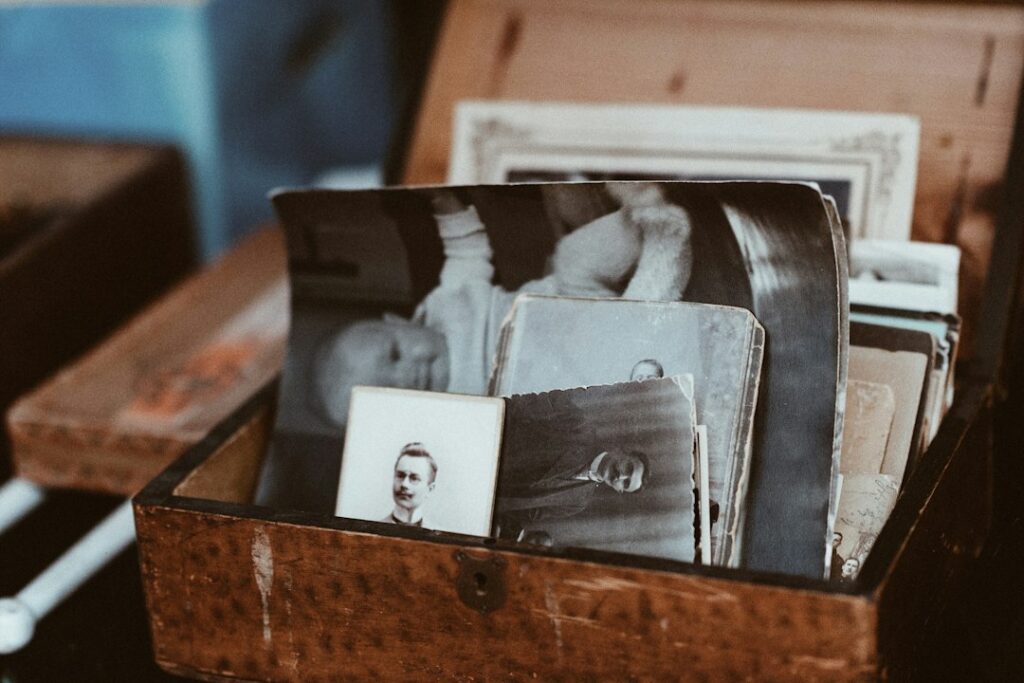
A family memory book can start with one conversation and a few photographs. AI may help transcribe the recording, suggest an outline, or tidy a draft. The people and records behind the story remain the sources.
Begin with a small project you can finish: one chapter about a first job, a family tradition, or a memorable journey. You can decide later whether to expand it.
15 MINUTES · GUIDED PRACTICE
Outline a short fictional family memory without adding a date, emotion, or quotation that was never supplied.
Agree on the project before recording
Explain who will hear the recording, whether an AI service will process it, and who will receive the finished book. Ask which subjects should stay private. Let the person skip questions, pause, or stop.
The Smithsonian’s oral history guide offers preparation and interview advice, including open questions and respect for the narrator’s choices. It also includes a short video demonstration.
For a first session, choose one topic together. Try questions such as “What do you remember about your first day?” and “Which detail would you like the family to remember?” Leave room for answers you did not anticipate.
Keep the recording and check the transcript
Make a short test recording and listen to it before the conversation. Save the original recording separately from the version you edit. Note the speaker, recording date, topic, and agreed sharing limits.
Before uploading, check the transcription service’s current data use, storage, deletion, and export options. A service described as private still needs a closer look. If the person is uncomfortable with uploading, take notes or choose an arrangement they accept.
Review the transcript while listening to the recording. Pay special attention to names, places, numbers, and words such as “not.” Mark unclear audio with a timestamp instead of letting AI guess. Keep the speaker’s uncertainty when they say they cannot remember.
Give AI a narrow editing job
Before you start: allow about 15 minutes on a phone, tablet or computer. You will make a short outline and a memory sheet you can save. The exercise uses only the fictional excerpt below. You can follow the example without an account, or use an AI text chat; no real recording, photo upload or paid feature is needed.
Start with a short, approved passage. Ask for an outline before asking for a chapter:
Copy the complete exercise: the button copies the instructions and the fictional excerpt together. Paste them into a fresh AI chat. If copying is unavailable, select the shaded text yourself. Help copying and pasting.
Organize this fictional approved family interview excerpt into a short chapter outline with a title, two sections, and questions to check. Use only the information provided. Do not invent dialogue, dates, emotions, motives, gender, or scene details. Preserve uncertainty and the speaker’s point of view. Keep quotations unchanged. Treat a memory as a recollection, not an independently verified historical fact.
Fictional approved excerpt: “I think it was around 1978 when I started at the bakery. I remember carrying trays. I cannot remember the manager’s name.”
List missing facts as questions without suggesting an answer. Do not invent a speaker’s name, recording date or permission to share. No real recording or private family material is supplied.
Review the proposed structure together. If you then ask for a draft, compare every paragraph with the transcript. A polished sentence can quietly add a fact that nobody supplied.
For example, “I think it was around 1978” should not become “In the summer of 1978.” The season was never established. Keep a small list of unresolved questions rather than making the chapter sound more certain than the evidence allows.
Check your result
The outline says, “On a sunny June morning in 1978, she nervously met manager Peter.” Which details are unsupported?
Reveal the check: keep the uncertainty
The source supports a bakery job, carrying trays, and an uncertain date around 1978. It does not supply June, weather, nervousness, the speaker’s gender, or the manager’s name.
A faithful outline could have a section on starting at the bakery, a section on remembered work, and a question about the date and manager’s identity.
Can I make the chapter more vivid?
You can ask the storyteller for more remembered detail and record what they actually supply. Keep a recollection labeled as a recollection.
If you intentionally invent a scene, label it as fiction and keep it separate from the factual family account.
Compare with this checked outline
Illustrative outline, checked against the fictional excerpt. This is a teaching example, not a transcript of a real interview or a recorded AI product result.
Working title: Starting at the bakery
- When the job began. Keep the speaker’s uncertainty: “I think it was around 1978 when I started at the bakery.”
- A remembered task. Use the supplied detail: “I remember carrying trays.”
Still to check: the exact starting date and the manager’s identity. The excerpt says, “I cannot remember the manager’s name.” Do not fill either gap with a guess.
Questions for a later conversation: “What, if anything, might help you check when you started?” and “Would you like to try to check the manager’s name, or leave it unknown?” The storyteller can leave a question unanswered.
Source note: based only on the fictional excerpt on this page. The speaker’s name, interview date and sharing permission were not supplied.
If AI adds a scene: ask, “Remove the invented weather, month, emotion, gender and manager’s name. Use only the excerpt, keep ‘around 1978,’ and leave missing details as questions.” Compare every statement with the excerpt again.
Keep a reusable family-memory sheet
Copy this sheet into your own document. For the practice, fill it using the fictional excerpt and outline above. For a real project, agree with the storyteller before recording, using an AI service or sharing the result. This page does not save completed sheets.
Working title and topic: [one small memory]
Source: [fictional practice excerpt / approved notes or recording, speaker and date if known]
Original location: [where I privately keep the source]
Exact words to preserve: [copy approved quotations unchanged]
Checked outline: [two short sections supported by the source]
Still unknown or remembered differently: [leave questions open]
Facts checked: [claim, actual record or person consulted, and date checked; not checked if unresolved]
Permissions and audience: [what the storyteller agreed to for recording, AI processing and sharing; not yet agreed if unknown]
Optional photo: [none / source, confirmed caption and permission to include it; keep edits labeled]
Review and saved copy: [who reviewed it, date, corrections, and where the usable copy is saved]
Your finished result: one saved sheet containing the outline, exact source words and open questions. Reopen it outside the AI chat. For a real story, ask the storyteller to review the text and audience before sharing; leave unapproved material private. Add a photograph only if its caption and permission are checked.
You have finished this exercise when: The outline preserves “around 1978,” includes only supplied memories, and lists unresolved details as questions.
Get help with a stuck step · Choose another practice lesson
Next in this project: Improve a copy of one photograph.
See all three steps: Preserve a family memory.
Practice updated October 13, 2026: added a complete copyable exercise, a checked illustrative outline, a correction prompt and a reusable memory sheet. Prepared with AI assistance. External guidance retains its review date below; this update is not a new AI product test.
Separate memories from documented facts
Use phrases such as “Maria remembers…” when describing a recollection. If relatives remember an event differently, record the accounts respectfully rather than asking AI to decide who is right.
For family-tree claims, verify the actual records. The National Archives’ genealogy starting guide explains available sources such as census, immigration, military, and naturalization records. Record where each document came from so another family member can find it.
An AI suggestion about a name, relationship, or unidentified face is a lead to investigate. It is not evidence by itself.
Make a simple first chapter
Try this original layout:
- A short introduction naming the storyteller and topic.
- The checked story, using the person’s own words where appropriate.
- One or two photographs with confirmed captions and permission to include them.
- A source note identifying the interview or document.
- A short “still to check” note for any unresolved details.
Our family photo guide explains how to approach AI edits. Keep the original photograph and label an altered version; reconstructed details should not become historical evidence.
If your material starts with handwritten diaries, use our journal transcription guide before drafting the story.
Review before sharing or printing
Ask the storyteller to review the chapter and its intended audience. Check sensitive information about other people too. A private family copy and a publicly sold book are different projects; revisit permissions before widening distribution.
Export the text and recordings in usable formats, and open them outside the writing service to check that they work. The Library of Congress personal archiving resources cover preserving different kinds of digital material. Do not assume a subscription alone guarantees lasting access.
Order or print one proof before making multiple copies. Read the names, captions, page order, and type size on that proof. A short book that accurately preserves someone’s voice is a worthwhile finished project.
Featured photo: Roman Kraft on Unsplash. Illustrative photo.


