

Modern work in America is changing a lot. Now, knowing how to manage technical stuff is just as important as old-school management. With automation taking over, workers need to learn how to work with complex algorithms.
This change is a big deal for your career. Learning to lead automated systems is key to growing professionally. In the AI job market, being ready to move from simple tasks to complex digital management is essential. Getting good at these skills means you’ll stay relevant in a fast-changing world.
The Evolution of Workplace Competency
Today, we see a big change in what makes a professional valuable. Technology is changing fast, about 10 times quicker than in the 20th century. This means you need to think differently about your role and how you help your company.
Shifting from Manual Execution to Algorithmic Oversight
Many jobs are changing because of AI displacement. Automated systems are doing tasks that used to be done by people. Now, your job is not just about doing tasks. It’s about managing the systems that do them.
Your main job is to watch over these systems. This makes sure the work is done right and meets company goals. Learning to do this is key to staying important in today’s digital world.
Why Employers Are Prioritizing AI Management Skills
Companies want people who can use AI to make things better. They know that making changes needs human guidance. That’s why AI management skills are now a big deal for employers in the U.S.
Learning to work with AI can help you stay ahead. When you can lead AI workflows, you help companies stay stable during changes. Your career will grow if you’re ready to adapt to new technologies.
Understanding The New Hiring Test: Can You Supervise AI?
Your role in managing automated systems is now key. Companies are shifting to an AI-native organization model. Here, software does routine tasks, and humans guide the strategy. To thrive, you need to show you can handle The New Hiring Test: Can You Supervise AI? well.
Defining the Core Responsibilities of an AI Supervisor
An AI supervisor keeps digital workflows running smoothly. Stanford researchers found that about half of the Federal Reserve’s work can be done by AI. Your task is to make sure AI actions match company goals and ethics.
You connect human plans with machine actions. This means understanding how to turn business goals into clear tasks for AI. Effective oversight means guiding AI to prevent mistakes.
Key Metrics Used to Evaluate Your AI Leadership
Hiring managers look for signs of your leadership in AI settings. One key is your ability to spot AI mistakes. You should be able to find errors that AI might miss.
Another important skill is strategic troubleshooting. You’ll be judged on how fast you solve problems and fix them. Showing these abilities means you’re ready to lead in an AI world.
Essential Skills for Managing Artificial Intelligence
Technical skills are now available to everyone, not just engineers. New tools let you lead AI projects yourself. To do this well, you need both tech smarts and deep knowledge of your organization. This way, you can move from just using AI to shaping your team’s digital future.
Developing Technical Literacy for Non-Engineers
You don’t need a computer science degree to manage today’s software. The rise of “vibe coding” makes it easier for non-techies to work with AI. Now, you can tell AI what to do in simple terms, without needing to write code yourself.
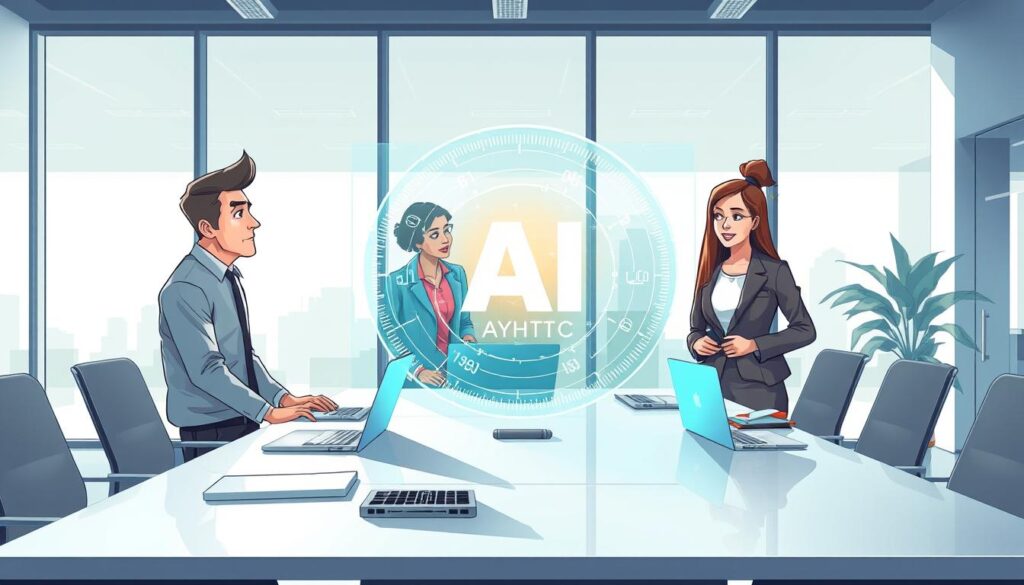
Mastering Prompt Engineering and Model Fine-Tuning
To make sure your AI tools meet your goals, you need to learn how to fine-tune them. Knowing how to craft good prompts for AI can get you better results. Also, model fine-tuning lets you adjust AI to fit your specific needs and work flow.
Identifying Bias in Algorithmic Outputs
As you manage these systems, watch out for AI bias. AI tools can reflect the biases in their training data, leading to unfair results. Your job is to check these outputs for fairness and accuracy in your team’s work.
Ensuring Ethical Compliance in Automated Workflows
Keeping AI ethics in check is key to avoid mistakes that could harm your company’s image. Through AI training, you can learn to set limits that keep AI within legal and moral standards. This way, your team uses technology wisely and consistently performs well.
Navigating the Human-AI Collaboration Dynamic
Success in today’s workplace comes from balancing human insight with machine speed. Human-AI collaboration is not about letting machines do everything. It’s about guiding the process to meet your standards.

Balancing Automation with Human Intuition
Using a tool and supervising it are different skills. Supervision means knowing what’s right to spot mistakes. You need your intuition to catch errors machines might miss.
Combining your experience with machine efficiency creates a strong team. This mix lets you work faster without losing the human touch. Trusting your gut is as important as trusting the data.
Strategies for Troubleshooting AI Performance Issues
Even top systems face technical problems. A proactive AI agent management strategy keeps you productive. When output quality drops, you must find the problem fast.
Begin by checking the input and context given to the model. Often, AI performance issues come from unclear instructions, not the tech itself. Sharpening your prompts can quickly fix the problem.
When to Intervene in Machine Decision-Making
Knowing when to step in is key. Intervene if the machine’s output doesn’t match your values or ethics. Precision is vital, and you should always override decisions that seem wrong.
Maintaining Quality Control in AI-Generated Deliverables
Quality control is the last check in your workflow. You need a strict review for all AI-generated deliverables before they’re shared. This keeps your team’s work reliable and accurate.
See every automated draft as a starting point, not a final product. Your critical oversight safeguards your organization from mistakes. It keeps your reputation for quality high.
Preparing for the Future of the US Job Market
The US job market is changing fast, thanks to new technologies. The US Bureau of Labor Statistics says jobs in computer and information research will grow by 20 percent by 2034. This shows we need to learn about AI proficiency to keep up.
Certifications and Training to Boost Your Resume
To have a strong AI career path, get certifications that show you know your stuff. Look for programs from Coursera, edX, or cloud providers. They teach you how to use machine learning in real business settings.
Specialized training makes you a key player in your company. Whether you want to be an integrator, builder, or trust engineer, the right education is key. Continuous learning keeps your skills sharp as technology changes.
Adapting Your Professional Narrative for AI-Centric Roles
Your resume should show how you bring value in an automated world. When applying for AI-centric roles, talk about how you connect tech with business goals. Share examples of projects where you used automation to boost efficiency.
Focus on the results you got, not just the tools you used. Showing you’re skilled in AI proficiency means you can lead teams through digital changes. By updating your story, you become a leader in innovation, securing your AI career path for the future.
Conclusion
The shift toward an automated workplace is no longer a distant possibility. Your career trajectory depends on your ability to adapt to these rapid changes in the United States job market.
Building high levels of AI proficiency allows you to stay ahead of industry trends. You gain the power to direct complex systems, not just perform repetitive tasks. This shift changes your role from a simple operator to a strategic leader.
You should prioritize developing your AI management skills to remain competitive. Companies like Microsoft and Google rely on professionals who understand how to guide machine learning outputs. By sharpening these abilities, you become a vital asset to any modern organization.
Stepping into the role of an AI supervisor opens doors to new professional growth. You will lead teams that produce better results with greater speed. Start refining your approach today to ensure your long-term success in this digital era.