
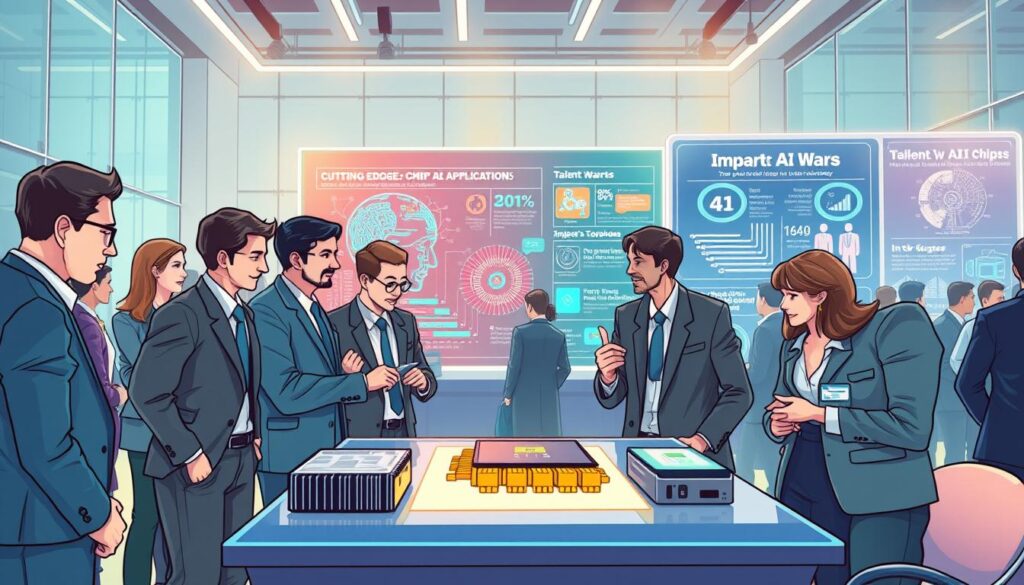
The world of technology is changing fast. We’re seeing huge investments in hardware and a big push for new talent. These US AI developments mark a new chapter for top companies.
Big names are focusing on growing bigger to stay ahead. AMD bought Untether, and NVIDIA got Enfabrica. Meta also grew by adding Rivos. These moves show how companies are racing for the best skills.
Grasping This Month in AI: Chips, Agents, and Talent Wars is key. Whether you’re investing or developing, knowing these trends is vital. Stay updated on AI trends to make smart choices. Use this knowledge to shape your strategy for the next quarter.
This Month in AI: Chips, Agents, and Talent Wars
Keeping up with AI news means watching chips, agents, and talent. The market is changing fast. It’s all about how physical and digital worlds meet, affecting many sectors in the U.S.
The United States AI developments to track this month
Big names are pushing AI limits. The AI chip competition is heating up as companies fight for the right hardware. At the same time, autonomous AI agents are getting better at doing things on their own.
These changes are linked. AI hiring trends show companies want engineers who get both the chip and software sides of AI.
How chips, autonomous agents, and hiring are connected
It’s clear now how chips, agents, and hiring are tied. Companies are building special teams to stay ahead. They’re using autonomous AI agents to turn research into real results.
This move needs a lot of investment. As the AI chip competition grows, getting top talent is key. The best researchers want places with the right tech and freedom to create.
What the latest announcements mean for your business or career
For workers, it’s time to update your skills. You need to know how to use both hardware and software. Knowing how to manage autonomous AI agents will be valuable soon.
Businesses need to watch AI hiring trends too. Whether you’re new or established, getting talent depends on your tech and AI use. Keeping up is the first step to succeed in this fast-changing world.
AI Chip Competition Moves Beyond NVIDIA
The way data centers power artificial intelligence is changing. A single player used to dominate the market. Now, specialized hardware is becoming more common. Companies are looking at performance, energy use, and software to improve their systems.
NVIDIA’s Blackwell platform and data center demand
The NVIDIA Blackwell platform is the top choice for high-performance computing. It’s fast at handling big language models. Even though it’s expensive, many businesses want it for their AI needs.

AMD Instinct accelerators and the challenge to NVIDIA’s dominance
The AMD Instinct series is a strong competitor. It balances memory and compute power well. Developers see it as a good option for growing AI workloads without being tied to one system.
Intel Gaudi and the search for lower-cost AI computing
Intel’s Gaudi line is for those who want to save money. It’s designed to be more affordable for big training tasks. This is great for companies that need to watch their budgets but also want good performance.
Custom silicon from Google, Amazon, Microsoft, and Meta
Big tech companies are making their own custom AI chips. This lets them focus on their software and hardware together. For example, Meta bought Rivos to improve its own hardware and software.
TSMC, advanced packaging, and the supply constraints shaping deployment
The whole industry depends on TSMC for making chips. New packaging methods are key for chip performance but slow down production. When planning AI projects, remember that chip availability can slow down progress.
AI Agents Shift From Demonstrations to Real Workflows
AI is moving from just showing off to actually doing real work. The focus is now on systems that can plan, reason, and do tasks on their own.

OpenAI, Anthropic, Google, and Microsoft compete on agent capabilities
The big tech companies are racing to make the best AI systems. OpenAI, Anthropic, Google, and Microsoft are adding features that let their systems understand and follow complex instructions.
How coding agents are changing software development teams
Coding agents are changing how developers work. These tools can write code, fix bugs, and manage projects with little help. They free up developers to focus on big ideas and solving tough problems.
Enterprise agents for customer service, research, and operations
Enterprise AI agents are key for making businesses run smoother. They help with customer service, research, and managing things inside the company. They offer speed and consistency, which humans often find hard to match.
Where autonomous systems need human approval
Even with all the progress, human oversight in AI is essential. Sometimes, AI can get things wrong or misunderstand instructions. It’s important to have humans check the work before it’s used.
Accuracy, security, and accountability risks to evaluate
AI systems that can do a lot on their own bring big risks. If they make a mistake in something important, it can cause big problems. It’s important to check and make sure they’re working right.
Why reliable tool use matters more than impressive demos
It’s tempting to get excited about AI demos, but reliable tool use is what really matters. A system that works every time is much more valuable than one that only works sometimes. Focus on making sure your system is consistent and can be trusted.
The AI Talent War Expands Across Research and Engineering
The search for top talent has grown beyond simple coding jobs. Today, the AI talent war changes how teams are built. It demands specialized skills that link theory and practice.
Why AI researchers and infrastructure engineers remain in high demand
Today’s development needs a mix of model designers and hardware builders. AI researchers push the limits of intelligence. AI infrastructure engineers make sure these models can run big. Without both, great ideas stay in labs.
Recruiting battles among OpenAI, Anthropic, Google DeepMind, Meta, and Microsoft
Big names like OpenAI, Anthropic, and Google DeepMind fight hard for top talent. They often compete for the same elite experts. This leads to team liftouts, where groups are poached to speed up projects.
How compensation, compute access, and research freedom influence hiring
Top candidates look for more than just money. They want access to big compute resources and freedom to research. To attract the best, offer a place where their work can make a big difference.
The growing value of skills in silicon, systems, data, and agent evaluation
The focus is now on those who know AI development inside out. Skills in silicon design, systems, and data are as important as model skills. Agent evaluation is key, as companies need experts to test AI in real life.
What the competition means for startups, universities, and public-sector employers
This intense competition is tough for small companies and schools. Startups can’t match big salaries, and schools lose faculty to industry offers. To compete, these groups offer unique benefits like equity, mission-driven work, or special projects.
Regulation, Energy, and Geopolitics Shape the AI Market
Your AI strategy now involves more than just code. It’s about global policies and resource availability. Scaling your operations means dealing with external pressures that can upset your plans.
U.S. export controls and their effect on advanced AI chips
The U.S. has strict AI export controls to keep a tech lead. These rules limit high-end graphics processing units to certain areas. This affects the global supply chain and how chips are allocated.
Data center electricity demand and the infrastructure bottleneck
The huge data center energy demand is a big problem. Many places can’t handle the power needed for new server farms. This leads to longer wait times and higher costs for businesses.
Federal and state policy developments affecting AI deployment
New US AI regulation is coming at all levels. It’s about safety and ethics. Keeping up with these rules is key to avoid costly changes to your AI systems.
How China, Taiwan, and global supply chains influence U.S. AI strategy
Taiwan’s chip manufacturing is a key risk for the tech world. Political tensions can change chip prices and availability quickly. Companies are looking to diversify to avoid these risks.
Questions you should ask about compliance and vendor exposure
Before investing in infrastructure, check your risk level. Ask if your vendors have plans for geopolitical instability or trade policy changes. Also, make sure your energy providers can handle your AI project’s energy needs.
What This Month’s AI Trends Mean for You
Understanding complex trends is key to staying ahead. You need to go beyond just knowing about them. Focus on practical steps that add real value to your work.
By focusing on strategic alignment, your team can stay flexible in a fast-changing world. This is important for keeping up with new technologies.
Decisions technology leaders should make about AI infrastructure
When planning your AI infrastructure strategy, think about long-term flexibility. Look at your current setup and how it might limit your future growth. It’s important to balance the cost of high-performance hardware with what your workloads really need.
Security and being ready to deploy should be top priorities. Don’t just follow the latest trends. Think about the cost and value of your choices. A good AI infrastructure strategy will help your business stay safe and ready for changes.
How developers can prepare for agent-assisted work
Autonomous systems are changing how we develop software. Start using agent-assisted development to improve your work. This means focusing on managing AI outputs, not just writing code.
Learn to work with tools and test frameworks. As you use agent-assisted development, checking outputs will become key. Learning to guide these agents will help you work on bigger projects faster.
Skills professionals should build to remain competitive
To succeed in an AI world, focus on developing future AI skills that include human judgment. Being able to understand how models work is essential. Also, learn to see how AI parts fit together in a big system.
Being able to make safe and ethical decisions is just as important as technical skills. By developing these future AI skills, you’ll be ready to lead in a complex tech world. Adaptability will be key for success in the future.
Signals investors and businesses should monitor next month
Watch how fast companies start using new AI workflows. If they move from testing to full use, it’s a good sign. Also, keep an eye on how they manage energy and hardware, as this shows stability.
Also, watch for changes in regulations that could affect your plans. Staying informed helps you make data-driven decisions for your business. Proactive monitoring helps avoid risks and find new chances.
Conclusion
The world of technology changes fast, with hardware, software, and people working together. You need to see how these changes affect your field. The quick growth of Chinese AI models shows how fast things can change.
Your plan should focus on the global AI race. Look for signs where money and talent are going. These signs help you know what’s real and what’s just a flash in the pan.
To stay strong, be quick to adapt to energy issues and new rules. Focus on systems that mix AI with human control. This way, your business stays up-to-date as things change.
Keep an eye on leaders like OpenAI, Anthropic, and Google for the next big thing. How well you understand these changes will decide your future. Stay alert and get ready to adjust to these new challenges.