Updated September 23, 2026.
AI can be useful before you enter the workshop: sorting measurements, comparing ideas, organizing a shopping list, and turning scattered notes into a project brief. It cannot inspect hidden conditions, certify a design, or make unfamiliar tool use safe.
Begin with a small, low-consequence project, such as organizing an existing drawer with removable dividers. Leave structural changes, electrical work, gas, load-bearing installations, and other hazardous work to appropriately qualified help. The aim is a clearer plan that you can check, not more confidence than the evidence supports.
Describe the result before requesting instructions
A vague prompt such as “build me a storage unit” invites assumptions. Describe the problem, the space, the materials you already have, and what must remain unchanged. State whether you want brainstorming, a materials comparison, or a checklist. Those are different jobs.
For the drawer example, measure the usable inside space yourself. Record width, depth, and clearance, and say whether the figures are inches or centimeters. A photograph can provide context, but do not ask a chatbot to infer exact measurements or material strength from it.
Help me plan removable organizers for an existing drawer. I will supply measured internal dimensions and the products I am considering. First list missing information. Separate my facts from your assumptions. Do not generate a cut list, load rating, or claim that a design is safe.
The useful first result is a list of unanswered questions. It might ask which objects must fit, whether the drawer closes over them, or whether you need to remove the inserts for cleaning.
Separate a concept image from a buildable plan
An AI illustration can help you compare colors and layouts. It may also depict impossible joints, inconsistent dimensions, or supports that disappear behind an attractive surface. Treat it as a mood board, not a measured drawing.
For a project that needs a real plan, use an appropriate plan from a credible source and follow the product and tool instructions. Ask AI to explain unfamiliar vocabulary in that plan, then check the explanation against the source. A polished diagram is no substitute for verified dimensions and suitable construction details.
Make a materials list that exposes uncertainty
Give the assistant the actual products you are considering, preferably with manufacturer descriptions. Ask it to organize them into items already owned, items to buy, and details still needing verification. Do not let it silently replace one adhesive, fastener, finish, or board type with another.
For a simple fictional budget, suppose inserts cost $18 and labels cost $6. The known subtotal is $24. If delivery is unknown, the total is not $24; it is $24 plus an unverified delivery charge. That small distinction prevents a neat-looking table from hiding missing information.
Check every quantity and calculation yourself. With cut lists, account for the actual material dimensions and the cutting process with a competent person or suitable verified tool. An AI answer saying pieces “fit perfectly” does not establish that they do.
Keep safety instructions attached to the source
The Consumer Product Safety Commission’s power-tool checklist emphasizes reading and following the owner’s manual, appropriate eye protection, and safe tool handling. A generic AI checklist should never replace the instructions for the exact equipment being used.
Do not remove guards or improvise a technique because an assistant suggests it. Stop when an instruction is unclear, the material is different from the plan, or an unexpected condition appears. Ask a qualified person to resolve the uncertainty before continuing.
Likewise, an app that generates room layouts or website designs is not a workshop safety monitor. Unless a particular product documents a specific sensing function, do not assume it can detect a dangerous machine condition, hidden cable, weak wall, or unsuitable material.
Use a review sheet before buying or building
- What did I measure, and what did the assistant assume?
- Which source supports the plan and each critical product requirement?
- Have I checked the quantities, units, clearances, and complete price?
- Which steps exceed my tools, experience, or ability to verify?
- What would make me stop and seek help?
For the drawer organizer, a successful first session might simply end with measured dimensions, two removable product options, and a shopping list. You do not have to generate a construction project to get value from AI.
Save the checked version alongside the original instructions. Our article on turning notes into a checked task list explains how to preserve unresolved questions instead of turning every suggestion into an action.
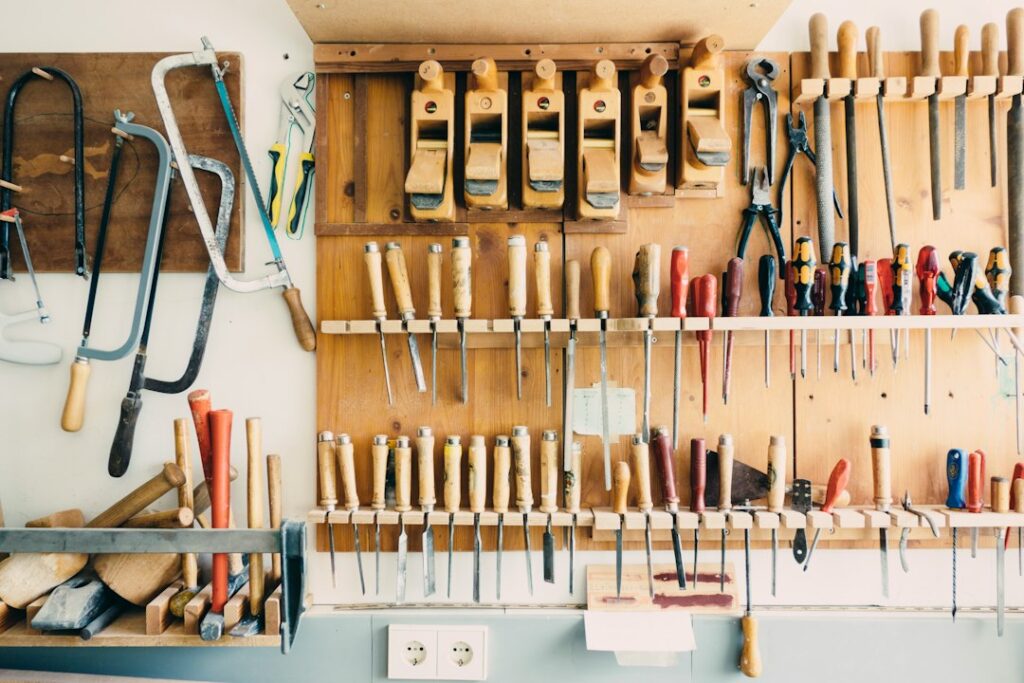
Photo by Barn Images on Unsplash. Illustrative photograph.
This article was created and updated with AI assistance. Sources were checked for this update. It provides general information; see our disclaimer.