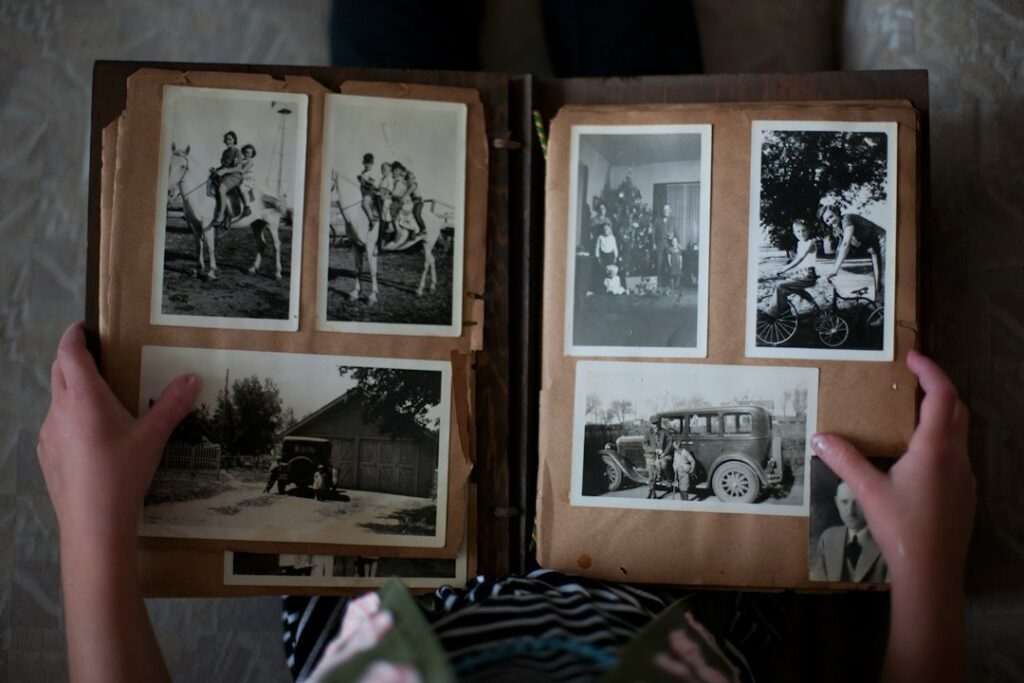
A box of photographs can contain more questions than captions. Who is beside your aunt? Was that holiday in 1978 or 1979? AI can help transcribe a note, arrange a timeline or turn your recollections into readable captions. It cannot recover a missing fact simply by writing a convincing sentence.
Start with a small collection you care about: ten pictures from one holiday, a few letters, or one relative’s account of an event. The goal is a record that another person can understand, with the uncertainties still visible.
GUIDED PRACTICE · BEGINNER
Write a caption that keeps the family history honest
You will finish with: A readable caption that preserves the source of each fact and leaves unknown history unresolved.
- Time
- 10 minutes
- Device
- Phone, tablet or computer
- AI tool or plan
- No account needed for the on-page example
Before you start: No earlier lesson or family-photo upload is required. Use the fictional photo notes.
Cost and access: the on-page example and checks are free. No upload or paid feature is required. Trying the prompt in another AI chat is optional; that service’s access limits and prices apply.
Practice updated October 9, 2026. Example answers are illustrative. Work at your own pace.
Keep the original separate from the interpretation
Make a clear digital copy of each selected photograph, including writing on the back where useful. Keep the original scan unchanged. Work on a separate copy if you crop, adjust contrast or experiment with AI editing. A future family member may want to examine details that an enhancement removed or invented.
The Library of Congress’s personal archiving advice recommends descriptive filenames, an organized folder structure and information about the people and subjects in photographs. Its guidance also explains why copies in separate locations and periodic readability checks matter. Organization is valuable even if you never use AI.
Give each item a simple identifier, such as “holiday-01.” Link its caption and notes to that identifier. Avoid renaming a whole collection around dates that are only guesses.
Record facts and uncertainty in separate fields
For each item, write the people, place, approximate date, who supplied the information and any unresolved question. “Aunt May says this was Brighton” is different from a location written on the original print. Preserve both the statement and its source.
Here is a fictional example: “holiday-01; two people beside a beach hut; one person identified by Rosa as her father; location possibly Brighton; date unknown; pencil note on reverse partly unreadable.” That is useful information. Changing it to “Rosa’s parents enjoying Brighton in 1978” would add several unsupported facts.
A spreadsheet, plain document or notebook can hold these details. Use whatever you can find and maintain easily. A complicated new app is not a prerequisite for preserving a small family collection.
Ask AI for a caption, not a reconstruction
Turn these fictional notes into a short caption: photo holiday-01 shows two people beside a beach hut. Rosa identifies one person as her father. The location is possibly Brighton. The date and the other person’s identity are unknown. A pencil note on the reverse is partly unreadable.
Use only these notes. Preserve uncertainty and who supplied the identification. Put missing details in a “Questions for family” list. Do not identify faces, invent dates or relationships, describe emotions, or add events.
Illustrative caption: “Two people beside a beach hut, possibly in Brighton. Rosa identifies one as her father. Date and the other person’s identity are unknown.”
Questions for family — illustrative: Who is the other person? Can anyone confirm the place or date and say what record or recollection supports it? Can the partly unreadable pencil note be read from the unchanged original? Keep unanswered questions unresolved.
Check three things: does the caption retain Rosa as the source; does “possibly Brighton” stay uncertain; and are the missing date, identity and handwriting still visible? Explain why a convincing caption cannot settle those questions by itself.
Compare the draft against your notes line by line. Check names especially carefully. A fluent caption can quietly replace “possibly” with certainty or imply that two people were married. Correct those changes before saving it.
If your chosen tool accepts images, you can ask it to attempt a transcription of handwriting. Require unclear words to be marked as unreadable. Check the transcription against the original yourself, zooming in where necessary. Repeating the same guess in several AI responses does not turn it into independent evidence.
Invite corrections without creating pressure
Share a small selection with relatives who want to help. Ask open questions such as “What do you remember about this place?” rather than supplying a story and asking them to agree. Record who answered and when. Different recollections can remain side by side.
AI can help organize those responses into a list of agreements and unresolved details. Remove private information before sending it to an external service, and do not have it decide which family member is telling the truth.
If a photograph prompts a wish to reach an old friend, our article on writing a reconnection message offers a respectful approach. Ask permission before circulating pictures that include other people, especially when a private family exchange might become a public post.
Label creative edits clearly
Colorization, facial animation and AI-created historical scenes can be interesting experiments. They are interpretations. A generated smile is not footage of how someone moved, and an imagined childhood scene is not a recovered photograph.
Keep those files apart from the originals and label them directly: “AI-colorized interpretation; original photograph is black and white,” or “AI-generated illustration based on a family story.” If you share an edited image, include the label with the image so it does not lose its context when forwarded.
Avoid presenting these activities as a treatment for memory loss or grief. People may respond differently to altered images of loved ones. Ask before creating an animation of a deceased relative for someone else, and accept that they may prefer the original.
Finish something small enough to use
Your first result might be a folder of ten originals, ten reviewed captions and a one-page list of unanswered questions. Check that another family member can open the files and understand the names. Save an easy-to-read copy of the notes, rather than leaving the only explanation inside a chatbot conversation.
A careful collection does not need a complete narrative. “We do not know yet” is an honest part of family history, and often the most useful invitation for someone else to contribute.
Which details did the AI add?
It writes: “Rosa’s father and his brother outside their Brighton holiday home, summer 1979.” Compare each detail with the fictional notes.
Reveal the unsupported additions
The second person was not identified as a brother. The notes do not establish that relationship.
A beach hut has become their holiday home, and a possible location has become certain.
Neither summer nor 1979 was supplied. Keep the date unknown and preserve Rosa as the source of the father’s identification.
If another attempt still guesses names or dates, keep your original caption with those fields marked unknown. Ask the person who supplied the memory or consult a dated record before changing them.
Help if you get stuck
It keeps guessing a year or a name
Ask it to use “unknown” rather than fill the gap. Keep the original note, the person who supplied each detail, and any different recollections separately.
An enhanced image seems to reveal a new detail
Compare it with the unchanged original. An AI edit may add plausible features; do not treat an invented detail as historical evidence. Label creative edits clearly.
Finish this practice
You have finished when: your caption is readable and every known fact, source and uncertainty remains traceable.
Recommended next lesson
Featured photograph: Laura Fuhrman on Unsplash. The stock photograph illustrates the topic; it is not evidence of a product test or personal experience.