

Every day, digital contracts demand your immediate attention. Most people scroll past lengthy blocks of text to reach a button. They ignore complex terms that govern their data and privacy.
A notable NameDrop experiment involved 543 college students. It showed that simply viewing online agreements does not mean they are understood. Many users treat these documents as obstacles, not as legal commitments.
Modern technology offers a solution to this problem. New tools help parse dense fine print, highlighting critical clauses. These systems act as a helpful review aid, allowing for faster evaluation of lengthy documents.
But, it’s important to remember that automated summaries should never replace your own judgment. While these programs provide helpful insights, they do not serve as a substitute for professional legal advice. Always exercise caution when navigating complex web policies.
Why Online Agreements Are Difficult to Review Quickly
Clicking “I agree” is often done without thinking about the legal impact. Most people face dozens of digital contracts monthly without reading them. If you were to read every terms of service and privacy policy, you’d spend nearly 250 hours a year.
How lengthy terms hide important commitments
Companies write these documents in complex legal language. They make it hard to understand by hiding important details in long documents. This strategic complexity means most people can’t figure out what they’re agreeing to.
Which clauses can affect your money, privacy, and account access
Agreements often have clauses that affect your money or privacy. For example, a privacy policy might let a company sell your browsing history. Hidden terms in a terms of service agreement could let a platform freeze your account or take your digital assets without warning.
Why “I agree” can create binding obligations
When you click “I agree,” you’re making a legally binding contract. Courts in the United States consider your click as informed consent. This means you’re bound by every word, even if it’s unclear or unfair. Knowing this is the first step to taking back control of your online life.
Can AI Read the Fine Print Before You Click Agree?
Artificial intelligence can now read through dense legal texts to find important information for you. It uses advanced AI contract review tools to turn complex text into clear, actionable insights. This doesn’t replace a lawyer but helps protect your digital life.
How AI extracts obligations, permissions, and restrictions
Modern software scans documents to find legal concepts. It looks for keywords and patterns to identify your obligations, permissions, and restrictions.
For example, tools like Fine Print can spot different consent formats across platforms. They help you see what you agree to and what companies can do with your data.
How language models summarize complex legal wording
Large language models, like those in Claude, simplify intricate legalese into easy-to-understand English. This legal document analysis lets you understand contract clauses without a law degree.
These models provide summaries and keep the original text for your review. This way, you can check the AI’s interpretation against the actual contract before deciding.
How AI identifies unusual or potentially risky clauses
AI is great at spotting unusual language that might threaten your privacy or finances. It flags sections that could pose risks.
Automatic renewal and cancellation requirements
Many services hide recurring charges in long documents. AI tools quickly find automatic renewal dates and cancellation steps. This saves you from unexpected costs.
Arbitration, class-action waivers, and governing-law provisions
These clauses limit your right to sue in court. An AI assistant will highlight arbitration agreements and class-action waivers. This ensures you know you’re giving up your right to a jury trial.
Data collection, sharing, and artificial intelligence training rights
You should always know how your data is used. AI can spot if a company uses your personal content to train artificial intelligence models. This is a growing concern in digital agreements.
Remember, detection is not the same as legal interpretation. While these tools are helpful, they guide you to make informed choices, not provide legal advice.
What AI Contract Review Tools Can Flag for You
AI tools are like digital magnifying glasses. They highlight risky clauses in long agreements. These programs scan thousands of documents, spotting patterns you might miss.
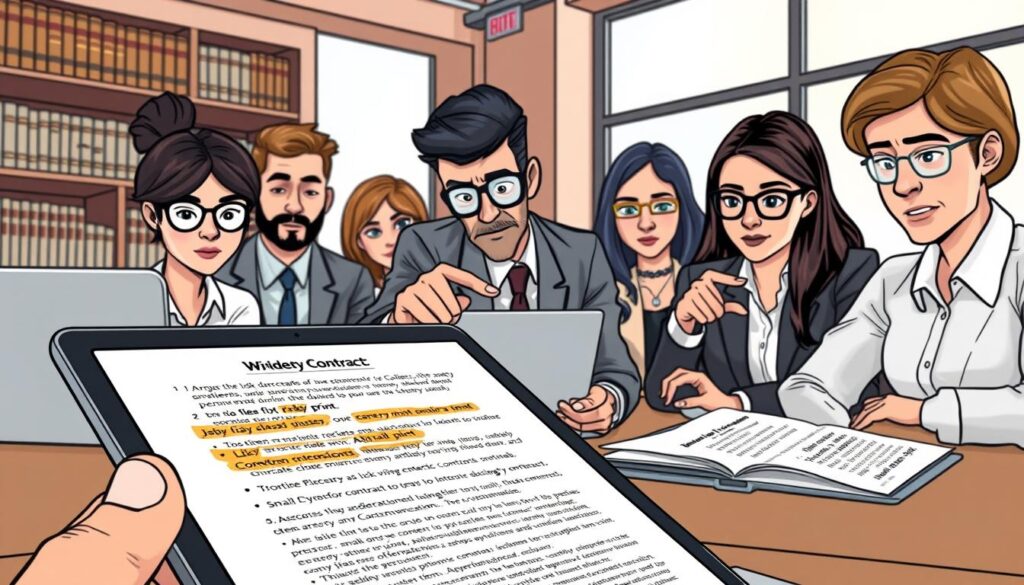
Unexpected fees, subscriptions, and automatic renewals
Many services have hidden costs that kick in after a trial ends. An AI tool can find an automatic renewal clause that might surprise you with extra charges. It tells you when to cancel to avoid these charges.
Broad permissions to use your content or personal data
Companies often take broad rights to your photos or documents. AI spots aggressive data sharing policies that let third parties see your private info. This lets you decide if the service is worth the privacy risk.
One-sided termination and account suspension rights
Some agreements let companies close your account anytime without warning. AI highlights these unbalanced terms, showing who has the power. This helps you understand the risk of losing access to your data or content.
Warranty disclaimers and limits on the company’s liability
Most digital contracts have clauses that limit your right to sue for damages. These sections often use complex legal jargon to cap the company’s financial responsibility. AI tools flag these liability caps so you know what you’re giving up.
Dispute resolution terms that restrict your legal options
You might have signed away your right to a jury trial with a mandatory arbitration clause. These provisions force you to resolve conflicts privately, not in public courts. Spotting these early ensures you know the limits on your legal options.
How to Use AI to Examine Terms Before You Accept Them
You can change how you deal with long agreements by using AI. Follow a clear process to keep your data safe and understand legal terms better.

Paste or upload the agreement safely
Remove sensitive information that the tool does not need
Before sending the text, remove personal info. Take out your name, address, bank numbers, and social security numbers. The AI just needs the legal parts for analysis.
Check whether the service stores submitted documents
Always check the AI tool’s privacy policy. Some, like Fine Print, delete your text after use. Others might keep it. Choose tools that protect your data well to keep it safe.
Ask targeted questions instead of requesting only a summary
A simple summary might miss important details. Ask the AI specific questions about AI training rights and data ownership. Also, find out about the content license and how to opt out of data sharing.
Compare the AI’s findings with the original language
AI might get complex legal terms wrong. Use its findings as a guide but always check them against the real text. If the AI warns about a clause, read it yourself to see the real risk.
Record important deadlines, fees, and steps for opting out
After reviewing, make a checklist of your findings. Note renewal dates, hidden fees, and how to opt out of services. This helps you manage your subscriptions and avoid surprise charges.
Where AI Contract Summaries Can Mislead You
It’s key to know when automated tools fall short. These tools are fast but lack the human touch needed for complex legal issues. Relying too much on a language model can make you feel overly secure about your rights.
Why AI can misunderstand ambiguous or industry-specific language
Legal texts often use words with deep meanings in court. An AI might see a word as it does in everyday life, missing its specialized meaning in certain fields. This misunderstanding can lead to misinterpretation of your duties.
How missing definitions and linked policies change the meaning
Many contracts link to other documents or policies. If an AI misses these, it can’t give a full view of the contract. For example, data retention details are often in separate privacy notices that AI might overlook.
Why a risk flag does not automatically mean a clause is unlawful
An AI’s “risk” flag just means it’s seen a pattern. It doesn’t mean the clause is illegal. Remember, a warning signal is just a hint to look closer, not a legal verdict.
How outdated models may overlook recent legal or policy changes
The law changes fast, with new rules popping up all the time. If your tool is old, it might not know about these changes. Using outdated info can put you at risk of terms that courts won’t enforce today.
When you should ask a qualified attorney for advice
For big deals like employment contracts or property leases, you need a lawyer. A human lawyer can offer the depth and strategy that AI can’t. Always get legal advice if you’re unsure about your data retention rights or if the deal is risky. Personalized legal advice is the best way to protect yourself.
How to Protect Your Privacy and Make a Better Decision
Before using AI to review a contract, check the tool first. Your privacy depends on knowing how these services use your data. Always verify that they don’t keep your sensitive data for training.
Review the AI provider’s data retention and training policies
Many AI tools save your input to get better. If you upload a private contract, you might share confidential info. Check the privacy policy to make sure your data stays private and isn’t used for public models.
Use official copies of terms from the correct website or app
Don’t rely on summaries or old versions of legal documents. Always get the latest terms from the company’s official website. Using outdated or unofficial copies can lead to misleading results.
Check the agreement’s version date and incorporated documents
Legal agreements often link to external policies. Make sure you’re looking at the right version for your account status. Missing an incorporated document can mean you’re not aware of important rules.
Separate routine consumer terms from high-stakes agreements
Not all contracts need the same level of review. A simple social media sign-up is different from a mortgage or business lease. Focus on clauses about account suspension, which can lock you out without warning.
Decide whether to accept, negotiate, opt out, or walk away
After understanding the risks, decide what to do next. Look for any liability limitation that limits your right to seek damages. If the terms are too strict, consider walking away to protect your rights.
Conclusion
Dealing with online terms can be overwhelming. You spend almost 250 hours a year just to understand user agreements. A study with 543 students shows how much time this takes from your daily life.
Tools like ChatGPT or Claude can help a lot. They quickly spot hidden fees and tricky clauses. This way, you can understand what you’re agreeing to without spending days reading.
While technology is useful, it’s not a full replacement for your own judgment. AI might not always get it right, missing important details. Always double-check important information against the original text from companies like Google or Amazon.
Keep your personal data safe by avoiding public prompts. Make sure to check deadlines for opting out of certain programs. If an agreement seems risky or involves long-term legal issues, talk to a lawyer. Making smart choices is your best defense against unfair online terms.