Updated September 22, 2026.
If you remember bulky desktop computers, the arrival of the internet, or the first time you spoke to a phone, today’s conversational AI can feel like a sudden leap. The research behind it has a much longer history.
That history is useful because each breakthrough answered a particular question. A machine could become excellent at chess without becoming an all-purpose assistant. A robot could navigate a prepared room without being ready to manage a household.
These six moments are a starting point, rather than a complete timeline of everyone who contributed.
1950: Turing asks how we could judge a machine
In Computing Machinery and Intelligence, Alan Turing explored machine intelligence through an “imitation game” involving written exchanges. He turned a difficult philosophical question into a discussion of observable behavior.
The lasting question is easy to recognize in a chatbot conversation: what can you conclude from an answer that sounds convincing? Producing humanlike language and establishing that an answer is true are different tests.
1956: A research field gathers at Dartmouth
The Dartmouth Summer Research Project on Artificial Intelligence, organized by John McCarthy, helped establish AI as a field of research. Researchers considered whether aspects of learning and intelligence could be described well enough for machines to simulate them.
This was a research ambition. It was not the arrival of a finished intelligent machine. Keeping an ambition separate from an achievement is still useful when reading technology announcements.
1966–1972: Shakey connects planning with movement
At SRI, then known as the Stanford Research Institute, researchers developed Shakey the Robot. It combined perception and planning to find routes and rearrange simple objects.
The project demonstrated that AI research could involve action in a physical environment, not just answers on a screen. It also gives us an early example of why the setting matters: a result in a research environment is evidence about that environment, not proof of dependable performance in every home.
1997: Deep Blue wins a chess match
IBM’s Deep Blue defeated Garry Kasparov, the reigning world chess champion, in a six-game match under standard tournament conditions in May 1997. Kasparov had won their previous match in 1996.
This was a major achievement in a game with explicit rules and a clear result. The machine’s strength came from specialized chess computation. Winning the match did not establish that the same system could explain a medical bill, cook dinner, or learn any unfamiliar job.
For someone who remembers the headlines, that distinction helps explain why a dramatic AI victory did not immediately produce a household robot.
2017: Researchers introduce the transformer
The paper Attention Is All You Need introduced a neural-network architecture called the transformer. Its original experiments focused on machine translation.
An architecture is a design for how a model processes information. This particular design used attention mechanisms to weigh relationships within sequences. You do not need the mathematics to see why the milestone differs from a product launch: it was a research contribution that other developers could build on.
2022: ChatGPT puts conversation at the center
OpenAI introduced ChatGPT on November 30, 2022, as a research preview with a conversational interface. People could ask follow-up questions and revise their requests through a dialogue.
The original announcement also acknowledged plausible-sounding incorrect answers. Both facts belong in the story: the interface made the technology easier to approach, and fluency did not settle the question of reliability.
As an interpretation of these milestones, one important change was the relationship between person and computer. Instead of needing to understand a research system or watch a specialist demonstration, a reader could begin by typing an ordinary request.
A history of different achievements
AI history is not a single machine steadily becoming human. These examples involve different goals: imitation, planning, physical movement, game playing, translation, and conversation. A breakthrough in one area can be important without answering every question in the others.
That gives you a useful way to read the next announcement. Ask what changed, what evidence demonstrates it, and what remains outside the test. You can be impressed by progress while still wanting a precise account of it.
For the next part of the story, read What Does AGI Actually Mean? It explains why a claim about general intelligence needs more detail than a striking demonstration.
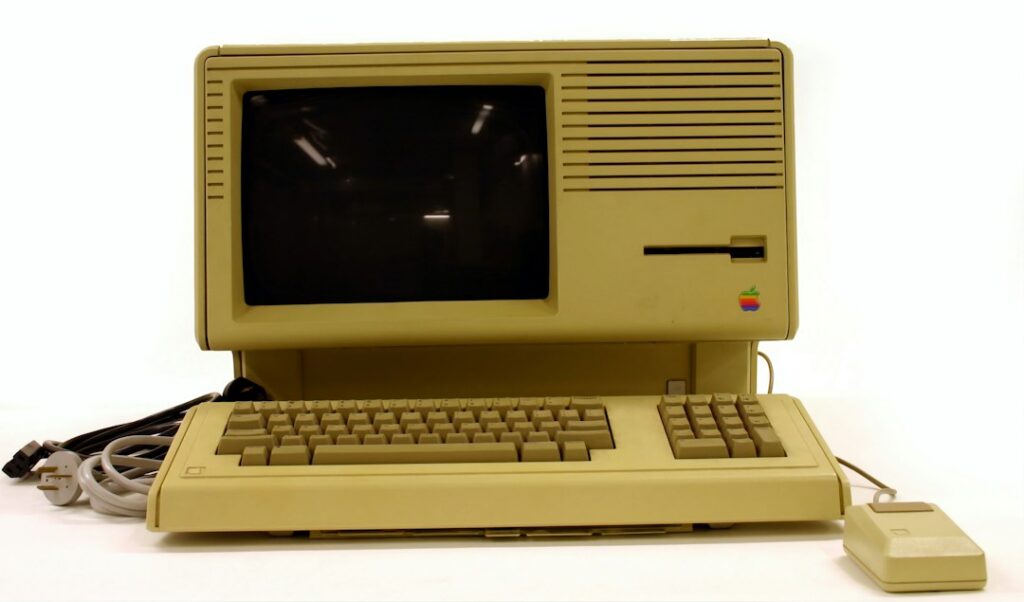
Photograph by Museums Victoria on Unsplash. Vintage personal computer used as a historical illustration.
AI disclosure: This article was drafted and revised using AI. Read our full disclaimer.