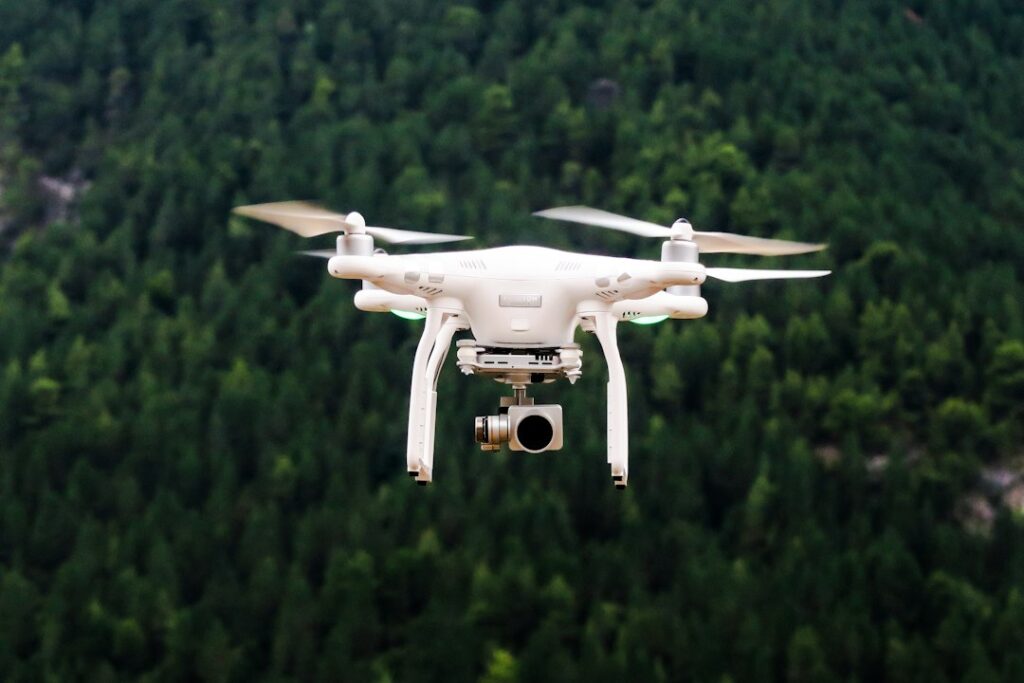
A drone can produce impressive aerial pictures. A useful drone service goes further: it helps someone answer a specific question about a property, crop, worksite, or asset. AI may help analyze the images, but the customer ultimately needs a trustworthy result and a clear next step.
If you are considering offering a service or hiring one, start with the decision the report should support. Buying a drone and an AI subscription does not by itself create expertise, customers, or permission to fly.
Separate the flight from the analysis
Several different capabilities are often bundled together under the phrase “AI drone.” Flight controls keep an aircraft stable. A planned route may automate part of image collection. Computer vision may then flag objects or patterns in photographs. A language model might draft a written summary of the findings.
These capabilities are not interchangeable. Software that identifies a possible defect in an image has not established that the aircraft can fly safely without supervision. A fluent report also does not establish that the underlying measurements or interpretations are correct.
As one example of a real application, NOAA Fisheries describes using drones to collect observations of marine animals, including body condition and group size. The value comes from the research question and collection method. This does not mean an ordinary drone owner can undertake the same work without relevant expertise and permissions.
Define a deliverable someone can use
Consider an illustrative request from a building manager: identify roof areas that deserve a closer look. A useful deliverable might contain dated photographs, marked locations, descriptions of visible observations, and a list of areas the imagery could not assess.
“Possible surface irregularity visible here” is a different claim from “this roof is structurally safe.” The second claim may require inspections or professional judgment beyond what aerial images can establish. Similar distinctions apply to crop stress, construction progress, and equipment condition.
Before agreeing to a job, write down what is included and what is excluded. Specify the site, collection date, intended image detail, review process, file format, delivery time, and conditions that would require another visit. A modest report with clear limits is more useful than a sweeping promise.
Check operating requirements before quoting a job
For U.S. readers, the FAA’s commercial-operator guidance is the starting point for work or business flights under Part 107. It covers pilot certification, aircraft registration, operating rules, and circumstances requiring additional authorization or waivers. The FAA also provides Remote ID information.
Requirements depend on the operation. Do not treat an autonomous-flight feature, a property owner’s invitation, or an app’s suggested route as proof that a flight is permitted. Check the rules and restrictions for the actual location and operation; outside the United States, use the relevant aviation authority.
Agree with the client on access and handling of images as well. Avoid collecting more information about neighboring properties or people than the job needs. Establish who can access the files, how long they are kept, and whether any supplier may reuse them.
Ask how AI findings are checked
Image analysis depends on the evidence available. Glare, shadows, poor resolution, obstructions, and unfamiliar materials can complicate interpretation. If a detail is not visible in the source image, a persuasive AI description cannot make it observed evidence.
Ask a provider to show how a flagged finding links back to the original photograph. Also ask how the system handles uncertainty and how qualified reviewers resolve disagreements. Keep original files separate from annotated or enhanced versions so that changes remain traceable.
NIST’s AI measurement guidance emphasizes evaluation in the intended context and documenting limitations. Applied here, that means asking about performance on the kinds of sites and images in your job, rather than accepting an overall accuracy number from an unrelated demonstration.
Test a service idea before expanding it
A sensible first commercial question is whether a potential customer already has a problem worth paying to solve. Speak with people in one field you understand. Ask how they currently gather the information, what is missing, and what a useful report would change.
For a small pilot project, account for planning, travel, safe image collection, weather delays, review, software, equipment maintenance, insurance arrangements, and client communication. These are planning considerations, not an earnings forecast. Fast image analysis may save time while other parts of the job still dominate the cost.
Buyers can request a small, clearly scoped sample deliverable before committing to a larger project. New providers can use a permitted practice project to discover weaknesses before making promises. In both cases, evaluate whether the result supports a better decision, not just whether the aerial footage looks impressive.
The strongest AI drone service combines appropriate flying skills, relevant subject knowledge, careful data handling, and evidence that the customer can inspect. AI can assist those strengths; it does not replace them.
Related reading: AI Quality Control: Finding Defects Without False Confidence.
Featured photograph: Jason Mavrommatis via Unsplash. Illustrative drone photograph; no specific AI capability or service is implied.
Updated September 25, 2026. This AI-assisted article draws on the linked sources. Hypothetical examples are labeled as illustrative. It is for general information; see our disclaimer.


