Growing fresh food in space is real research, not just a scene from science fiction. Astronauts have grown plants aboard the International Space Station, and engineers continue to investigate food systems for longer missions. AI could help monitor plants and manage limited resources, but it is only one part of a much larger engineering problem.
The useful question is not whether a computer can run a futuristic greenhouse. It is which tasks have been demonstrated, under what conditions, and with how much help from people and supplies from Earth.
What has already been demonstrated?
NASA’s account of growing plants in space describes Veggie, a small plant-growing system aboard the space station. It has produced crops including lettuce and other leafy vegetables, with some harvests eaten by crew members and samples studied by researchers. These crops supplement food supplies; this is not an account of a complete, self-sufficient diet.
The same NASA explanation describes the Advanced Plant Habitat as an enclosed, automated research chamber with cameras and sensors. Systems control conditions including moisture, temperature, and water distribution, while a team on the ground remains involved. Automated control is an important achievement, but calling every sensor-controlled chamber an AI farm would obscure how it actually works.
Automation and AI do different jobs
Ordinary automation follows specified rules. For example, a controller can switch equipment on when a sensor reading crosses a set limit. Machine learning instead builds a model from examples, perhaps to recognize a pattern associated with plant stress. Either approach can be useful; the more complicated one is not automatically better.
A 2021 NASA research presentation on smart crop systems proposed using databases of plant responses to stress to develop AI algorithms for crop production. That is a research direction, not evidence that an autonomous AI system already supplies an entire space mission.
Imagine a future monitoring system that flags an unusual change in leaf appearance. Its practical value would depend on whether the alert is reliable, whether the underlying problem can be identified, and whether someone or something can correct it. Recognizing a symptom and repairing the growing system are different tasks.
Why space makes familiar gardening problems harder
Plants need a workable balance of water, nutrients, and air around their roots. NASA explains that fluids behave differently in microgravity, which complicates maintaining that balance. A watering method that works in a garden cannot simply be assumed to behave the same way in orbit.
There are also system-level questions. What supplies are consumed? How much electricity and crew time are needed? Can equipment be cleaned and repaired? What happens if a sensor fails during a long growing cycle? A promising harvest does not answer all of these questions.
Orbital experiments, a greenhouse on Earth, and a proposed surface habitat on another world are different environments. Results from one can inform the others, but the conditions must be stated. A photograph of plants under colored lights is not proof of where they were grown or which technology controlled them.
A successful competition is a step, not a finished mission
NASA’s 2024 Deep Space Food Challenge results illustrate this distinction. Teams demonstrated food-production technologies during an eight-week testing period on Earth. The competition considered practical issues including food safety, palatability, and production, rather than judging attractive concepts alone.
Such demonstrations can reveal useful approaches and weaknesses. They do not establish that a system has completed years of operation in space, that it needs no replacement parts, or that every crop and nutrient requirement is covered. Different food technologies may ultimately complement stored supplies rather than replace them all.
How to read the next space-farming headline
Look for four details before sharing an exciting claim. First, where was the system tested: a laboratory, an Earth-based simulation, or space? Second, what did it produce, and for how long? Third, which tasks were automated, which used AI, and which needed people? Finally, what inputs and failures were included in the evaluation?
For an AI claim, also ask what comparison was used. Did the model improve performance over a simpler controller, an existing method, or a human decision? Better-looking plant images and a sophisticated dashboard are not measurements of reliability or food production.
There may be lessons for farming on Earth, particularly around controlled growing conditions and careful resource monitoring. Whether a particular approach is worthwhile here still depends on local energy, labor, equipment, and crop costs. A design suitable for a spacecraft can be too expensive or unnecessarily complex for an ordinary farm.
Space farming is interesting precisely because it combines biology, hardware, software, and human judgment. Understanding that combination makes the real progress more impressive—and helps separate a working experiment from a promise about a future colony.
Related reading: AI in Conservation: From Signals to Fieldwork.
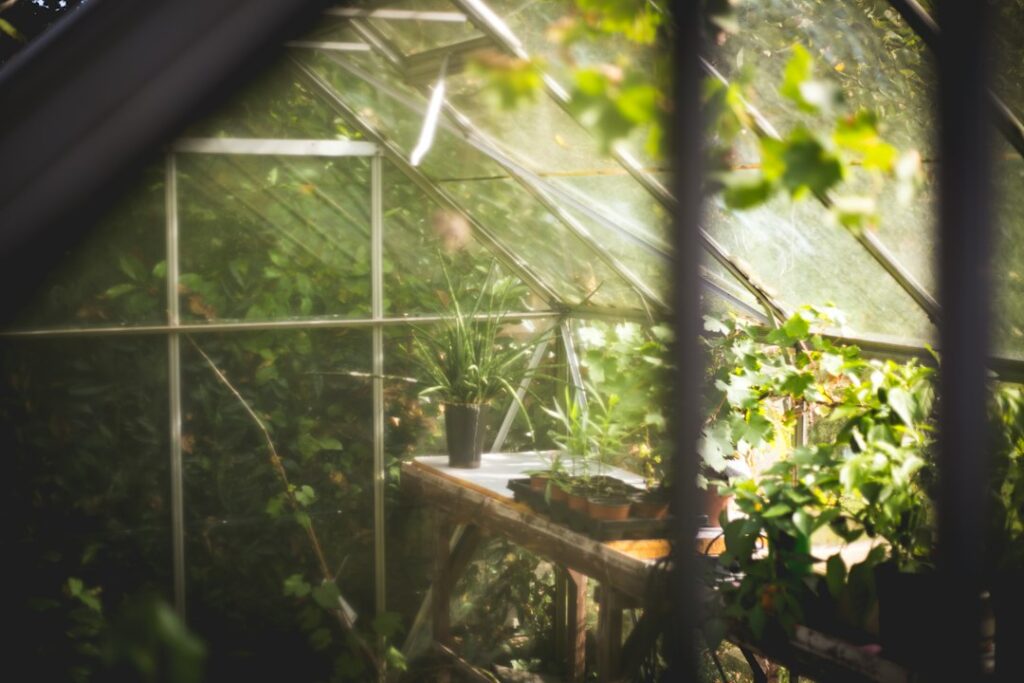
Featured photograph: Thomas Verbruggen via Unsplash. Illustrative greenhouse on Earth, not a space experiment or an AI-controlled facility.
Updated September 25, 2026. This AI-assisted article draws on the linked sources. Hypothetical examples are labeled as illustrative. It is for general information; see our disclaimer.