
AI can support a particular task in heart care, such as finding a pattern that merits further testing. It is not a crystal ball, and an algorithm’s output is not a complete account of your cardiovascular health.
For patients, the useful question is simple: what does this tool add to the decision my care team is making? A clear answer should name the task, the information being analyzed, the intended patient group, and what happens after the result.
A concrete example of clinical AI
The FDA’s March 2024 clearance documentation for the Eko Low Ejection Fraction Tool illustrates a specific use. That version analyzes ECG and heart-sound recordings collected with specified equipment to help clinicians identify adults at risk who may have a left ventricular ejection fraction of 40% or less. Ejection fraction describes the proportion of blood pumped out of the left ventricle with a contraction.
The documentation says the result is an aid to assessment, not a diagnosis or a tool for monitoring people already diagnosed with heart failure. It also says a negative result does not rule out low ejection fraction and that further evaluation may be needed. These limits are part of understanding the tool, not fine print to ignore.
This example explains a regulated clinical use. It does not mean that every smart stethoscope, consumer watch, or chatbot has the same capability. Check the current labeling for the exact product and version in use.
Prediction, detection, and diagnosis differ
A risk estimate asks how likely an outcome may be. A detection system looks for a defined signal or pattern in the data it receives. A diagnosis combines relevant findings with a clinician’s assessment of the patient. Those steps can inform each other, but they should not be collapsed into “AI knows what is wrong.”
Imagine a fictional clinic example: software flags a recording for further review. The clinician checks the recording, symptoms, and history, then explains whether another test is appropriate. The flag has helped direct attention. It has not, by itself, established that the patient has heart failure or decided a treatment.
The same distinction applies to reassuring outputs. “No target pattern detected” is narrower than “nothing is wrong.” Ask what the tool was designed to look for and what falls outside that purpose.
What makes evidence relevant to you?
When a headline advertises impressive accuracy, ask what it counted as correct. Finding a pattern in stored recordings is different from improving outcomes after a tool is introduced into practice. Results in one hospital or patient group may not transfer unchanged to another setting.
- Was the tool tested on patients separate from those used to develop it?
- Were people with relevant health conditions and backgrounds represented?
- How often did it miss the target problem or flag someone who did not have it?
- Was it tested in the setting where it is now being used?
- Did the study measure a useful clinical outcome, or only a model-performance score?
These are questions to discuss with a care team, not a requirement to audit the software yourself. A responsible explanation should make uncertainty understandable without expecting a patient to interpret a technical paper alone.
Consumer recordings are a separate use
A home ECG recorder may help capture information for a clinician. It is not automatically equivalent to the tools used in a clinic. The device, recording method, software, and review arrangement all matter.
If that is the decision you face, see our explanation of KardiaMobile’s role and limits. If your device sends information to a monitoring program, ask who reviews it and when. Data transmission alone does not mean a clinician will respond immediately.
Bring three questions to an appointment
First: “What question is this AI tool helping answer?” Second: “How will you check the result?” Third: “What would change in my care because of it?” Ask for the clinical reasoning if a software result and your symptoms appear to disagree.
Do not change prescribed medicines or delay care because an app gives a confident answer. If you suspect a medical emergency, contact emergency services rather than waiting for an AI interpretation. The useful promise of clinical AI is support for a well-defined task within care—not a guarantee that a heart problem will be predicted or prevented.
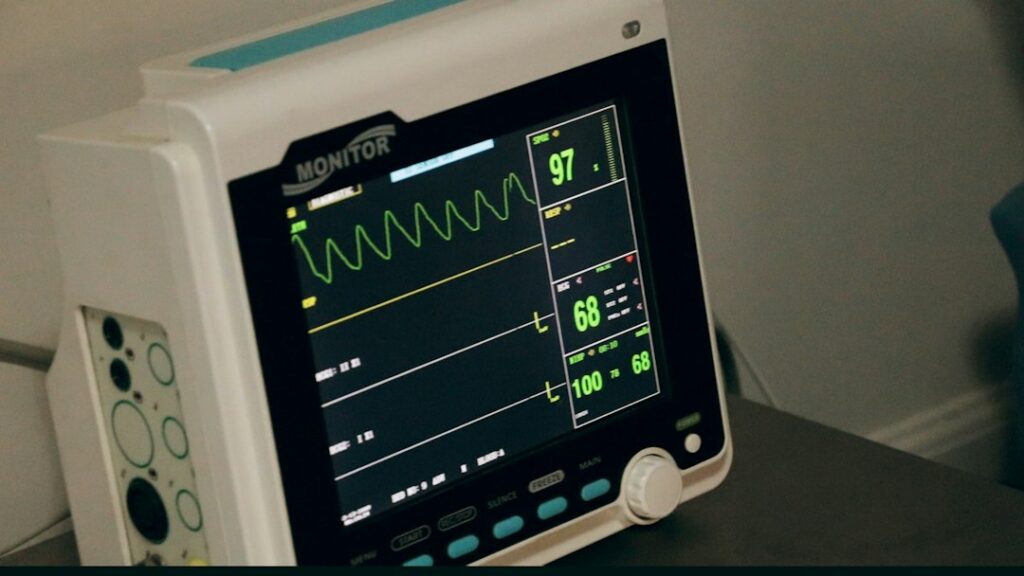
Photo: Jair Lázaro on Unsplash. Illustrative hospital monitor photograph, not the Eko tool.
Updated September 23, 2026. Prepared with AI assistance and checked against the sources linked in this article. This is educational information, not personal medical advice or a hands-on product test. See our disclaimer.



Pingback: AliveCor KardiaMobile: Your Heart Health Ally