
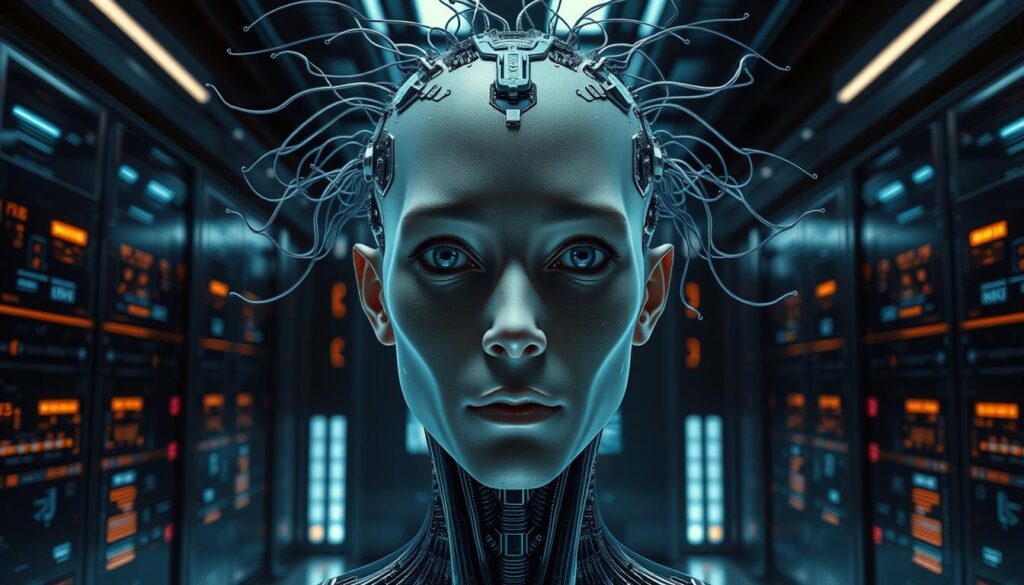
Imagine having a digital version of yourself. This version can think and act just like you. Thanks to neural AI, this idea is now possible. By studying your behavioral patterns, like how you type and what words you use, a highly personalized AI clone can be made.
This idea is both thrilling and raises big questions about safe AI development. When thinking about brain cloning, it’s vital to weigh the risks and benefits of this new tech.
Learning how to create a digital clone safely is essential. It lets us use its benefits while avoiding its dangers.
The Science Behind Neural AI Cloning
To understand neural AI cloning, we must explore brain mapping and neural networks. This process captures the subtle patterns in our daily talks. It aims to create a digital copy of our behavior and speech.
Brain Mapping Fundamentals
Brain mapping is key in making an AI clone. It studies brain activity to see how our thoughts are spread out. High-tech imaging helps map our brain’s connections. This lets us create smart algorithms that understand and mimic our thoughts.
After that, we use neural network translation to turn brain data into a model. This model is then trained with lots of data. It learns to act like our brain, making an AI clone that responds like us.
By mixing brain mapping basics with neural network translation, neural AI cloning opens up new areas in AI development. It brings us closer to personalized medicine and smarter computers.
Current Brain Cloning Technologies
Recent AI breakthroughs have led to advanced brain cloning methods. These are mainly thanks to EEG-based solutions and data-driven personality modeling.
EEG-Based Solutions
EEG-based solutions use electroencephalography to record brain activity. This lets us create a digital clone. It involves capturing brain signals and training an AI to mimic your thoughts.
CustomGPT makes this easier with a simple interface for collecting data and training AI.
Data-driven personality modeling looks at your online activities to build a profile. This profile trains an AI to act like you. By using many data sources, these models get very accurate at mimicking you.
EEG-based solutions and data-driven modeling are leading brain cloning tech. As they improve, we’ll see AI clones that really think and act like us.
How to Train an AI Clone of Your Brain (Safely)
To make a safe and true AI version of yourself, follow a clear plan. This plan includes several important steps. These steps make sure your AI clone shows your brain’s abilities and stays safe.
Thought Pattern Recording
The first key step is thought pattern recording. This means capturing how you think, including solving problems and making decisions. Tools like CustomGPT help by using your writings, talks, or personal data to create a digital version of your mind.
By looking at your digital stuff, the AI learns to think like you. This way, it can help or even stand in for you online.
Decision History Compilation
Another important part is decision history compilation. This is about collecting data on your past choices, including why you made them and what happened next. This data helps train the AI clone to make decisions like you.
Putting together thought pattern recording and decision history compilation is key. These steps help make sure your AI clone is both true to you and trustworthy.
Protecting Your Neural Data
The importance ofneural data protectionis huge when training an AI like your brain. As you make this digital copy, keeping your neural data safe is key.
Tools like CustomGPT focus ondata privacy, keeping your info secure. Remember, your neural data is sensitive and needs careful handling.

To keep your neural data safe, consider these steps:
– Choose platforms that valueAI safetyand privacy.
– Make sure your data is anonymized and encrypted.
– Keep your security up to date to fight off threats.
By following these tips, you can greatly improve your neural data’s security. Remember, the safety of your AI clone relies on the steps you take now.
Potential Risks and How to Mitigate Them
Training an AI clone of your brain safely needs a deep understanding of risks and how to avoid them. As you work on your AI clone, remember the dangers of misuse of personal data or unexpected actions by the clone.
Understanding AI Risks
Creating an AI clone means handling a lot of personal data. If this data isn’t kept safe, privacy could be at risk. Also, the AI clone might not do what you want it to, leading to bad results.
To lower these risks, regular auditing practices are key. This means checking the AI clone’s work and data handling often. This way, you can spot and fix problems early.
Setting Clear Boundaries
Another important step is setting clear boundaries for your AI clone. You need to decide what it can do, what data it can use, and what actions it can take. By setting these limits, you can greatly reduce the chance of the AI clone doing something wrong.
By knowing the risks and using strategies like regular checks and setting limits, you can make sure your AI clone works well and safely.
Practical Applications of Your Brain Clone
An AI clone can make your life more efficient and innovative. It has many uses, from making daily tasks easier to changing your career.
Personal Use Cases
An AI clone can boost your productivity by handling routine tasks. This lets you dive into more complex and creative projects. It also keeps your knowledge safe for future use or personal reference.
Key personal benefits include: better productivity, keeping your knowledge safe, and getting scalable mentoring in your interests.
Professional Applications
Professionally, an AI clone is very helpful. It helps manage tasks, offers insights based on your expertise, and trains others. It makes learning paths personal, automates decisions, and boosts your professional impact.
Professional advantages include: better task management, expert insights, and training others with your AI clone as a mentoring tool.
Using an AI clone is more than just adopting new tech. It’s a way to improve yourself and open new doors for growth in your personal and professional life.
The Future of Brain-AI Integration
Brain-AI integration is on the verge of a breakthrough. It promises to change how we think and interact with machines. Soon, AI might not just mimic us but also improve our thinking.
The future of AI is closely tied to working with human brains. This could lead to a new way of living. It could make us smarter and help with health issues.
AI advancements in neural networks and deep learning are key. These technologies are getting better. We’ll see smarter and more natural brain-AI connections.
The uses of brain-AI integration are endless. It could help in medicine and make us smarter. But, we must think about the ethics of these technologies.
In summary, brain-AI integration’s future is bright. By improving AI and understanding our brains better, we’ll discover new possibilities.
Conclusion
Training an AI clone of your brain could change many parts of life and work. You now know the science behind it and how to use it safely. This knowledge helps you use its benefits.
Your summary shows how vital it is to keep your neural data safe. It also points out the risks. This tech can change industries and make decisions better.
The future of brain-AI tech looks bright. It will likely get better and better. By keeping up with these changes, you can find new chances and lead in an AI world.