
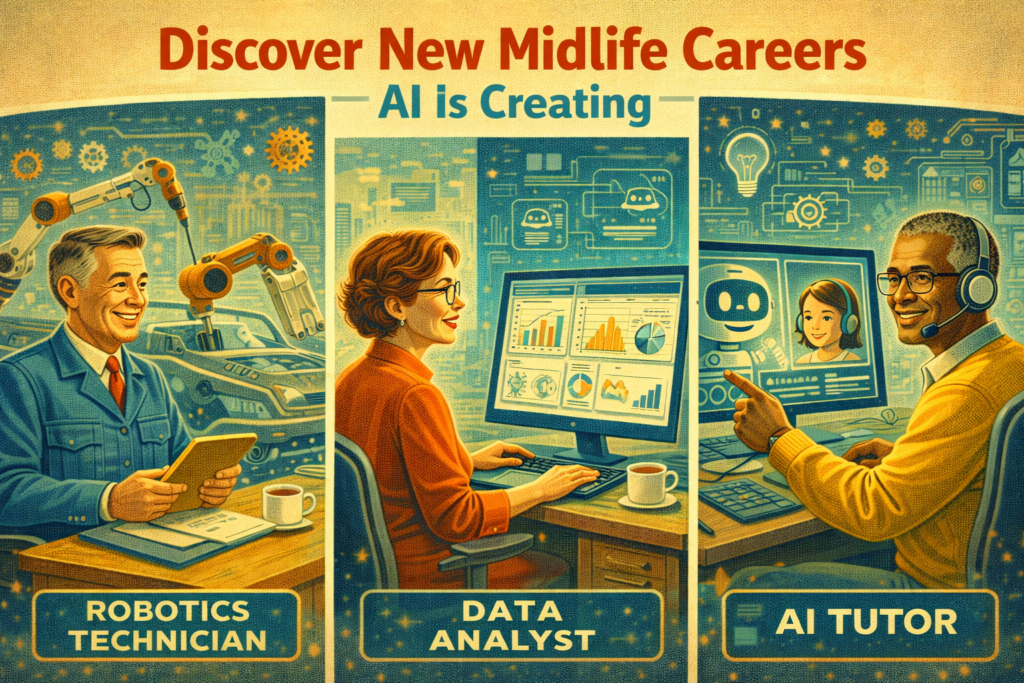
Modern technology is changing your industry fast. Many experienced workers worry about their jobs as automation takes over. This change is reshaping how businesses work in the United States today.
Key Takeaways:
- Automation transforms job stability in various sectors.
- Adapting to technology helps professionals stay relevant.
- Fresh roles value the deep wisdom of seasoned experts.
Technical fields are growing fast, often leading to a midlife career change for those seeking stability. To navigate these changes, you need to be proactive and open to learning. You can start reinventing your career path today.
There are exciting AI careers that offer growth and longevity. By focusing on lifelong learning, you can adapt to these changes while using your years of experience. These roles appreciate the wisdom you’ve gained over the years.
This guide will help you thrive in this period of big change. We’ll look at roles that value your unique background and embrace the future. Get ready to transform your work life and find new opportunities that match your skills.
Focus on the good things about this digital shift. Your experience gives you an edge in a world ruled by algorithms. Let’s explore the opportunities waiting for you in this evolving market.
Why Your Midlife Experience Makes You Perfect for AI Careers
The AI industry is facing a big skills gap. Your experience is more valuable than ever for a role in this exciting field. There’s a high demand for skilled AI professionals, creating chances for career changers.
Midlife professionals have skills and experiences that fit well in AI careers. Your years of experience have given you strong critical thinking, problem-solving, and communication skills. These are key for AI roles.
The Skills Gap AI Companies Are Desperate to Fill
The AI industry has a big skills gap. Companies struggle to find people with the right technical and soft skills. This gap is big in AI ethics, data curation, and AI implementation. Your experience can fill these gaps, making you a great candidate.
Many leaders over 50 talk about AI but lack real experience. This shows the need for people who understand both AI and business. Your midlife experience gives you a valuable business understanding for AI roles.
How Your Professional Background Translates to AI Roles
Your background has given you skills that fit well in AI roles. For example, your data analysis, project management, or customer service experience is useful in data science, AI project management, or AI-powered customer service. You can quickly adapt to new AI technologies and contribute to your new organization.
Why Age Is an Asset in the AI Industry
Age is not a barrier in the AI industry. In fact, your midlife experience is a big plus for a career shift into AI. Your maturity, stability, and professionalism are highly valued by employers. Your experience with technology also helps you understand how it can drive business success.
By combining your experience with new AI skills, you can find exciting career opportunities. Whether you want a new role or to start your own AI business, your midlife experience is a valuable asset.
New Midlife Careers AI Is Creating
New career paths are emerging thanks to AI’s rapid growth. This offers exciting opportunities for midlife professionals. AI is not just changing old industries but also creating new jobs that didn’t exist before.
AI Training Specialists and Data Curators
AI Training Specialists and Data Curators are key in AI development. They prepare and curate data for AI models. This ensures the data is accurate and unbiased.
What the Role Involves
They collect, clean, and organize large datasets. Specialists must also preprocess data for AI models. This includes handling missing data and normalizing it.
Key Responsibilities: Collecting data, preprocessing, annotating, and ensuring data quality.
Salary Range and Job Outlook
The salary for these roles varies by location, industry, and experience. On average, they earn a competitive salary, from $60,000 to over $100,000 a year.
The demand for these specialists is growing. This is because high-quality data is needed for AI training.
Prompt Engineers and Conversation Designers
Prompt Engineers and Conversation Designers are vital for AI systems that interact with humans. They design prompts that influence AI responses.
What the Role Involves
They craft effective prompts for AI models. It requires knowledge of language and context. They must also understand the AI’s goals.
Key Skills: Linguistic knowledge, understanding AI capabilities, and creativity in prompt design.
Salary Range and Job Outlook
Prompt Engineers and Conversation Designers are in demand. They earn from $80,000 to over $150,000 a year, based on experience and industry.
The outlook is promising. More companies are using conversational AI in their products and services.
AI Ethics Officers and Governance Consultants
AI Ethics Officers and Governance Consultants ensure AI is developed responsibly. They align AI with ethical standards and regulations.
What the Role Involves
They assess AI systems for biases and privacy issues. They need to understand ethical principles and legal regulations.
Key Responsibilities: Conducting ethical audits, developing governance frameworks, and advising on AI policy.
Salary Range and Job Outlook
AI Ethics Officers and Governance Consultants earn from $100,000 to over $200,000 a year. Their work is critical.
The demand for these professionals is expected to grow. AI is expanding into various sectors.
AI Implementation and Change Management Specialists
AI Implementation and Change Management Specialists help organizations adopt AI smoothly. They manage the change process to minimize disruption.
What the Role Involves
They plan and execute AI projects. They manage stakeholder expectations and prepare the organization for AI changes.
Key Skills: Project management, change management, and technical understanding of AI solutions.
Salary Range and Job Outlook
Salaries for these specialists range from $90,000 to over $160,000 a year. Experience and industry influence the salary.
The job outlook is favorable. Organizations are recognizing the need for effective AI implementation strategies.
Industry-Specific AI Career Paths for Career Changers
AI is changing the job market, opening new paths for midlife career changers. Industries like healthcare, finance, education, and law are being transformed. This creates new jobs that use your current skills.
Healthcare AI Coordinators and Medical Data Specialists
The healthcare field is using AI more for patient data and medicine. Healthcare AI Coordinators make sure AI systems work right and follow rules. Medical Data Specialists get medical data ready for AI to learn from, making diagnoses better.
If you’re in healthcare, you can move into these roles. You’ll need to learn about AI, data, and health informatics. There’s a big need for people who know both tech and healthcare.
Financial Services AI Analysts and Risk Assessors
In finance, AI helps with risk, fraud, and managing money. Financial Services AI Analysts use AI to understand financial data and predict trends. AI Risk Assessors check if AI decisions are safe for banks and follow rules.
If you know finance, you can switch to these AI jobs. Learning about AI, data, and models is key.
Educational AI Content Developers and Learning Architects
Educational AI is making learning more personal and effective. Educational AI Content Developers make learning materials that adjust to each student. Learning Architects plan how AI fits into education, making it better.
Teachers and education experts can move into these roles. You’ll need to learn about AI in education, making content, and designing lessons.
Legal AI Research Assistants and Document Reviewers
In law, AI helps with documents, research, and contracts. Legal AI Research Assistants use AI for legal research and help with lawsuits. AI Document Reviewers check AI’s work on legal papers, making sure it’s right.
Lawyers can switch to these AI jobs. You’ll need to know how AI works for legal research, documents, and finding evidence.
Building Your AI Skill Set Without Starting From Scratch
You can start a new career in AI without feeling like you’re starting over. Your past work and skills are a great base. They help you build a strong foundation for your new AI career.
Free and Low-Cost Certification Programs You Can Start Today
Many organizations offer free or low-cost AI certifications. Google’s TensorFlow Developer Certificate is a top choice for learning AI. These programs are a great starting point, letting you learn at your own pace.
Microsoft’s Professional Program in AI and edX’s AI courses from top universities are also great. IBM’s AI Engineering Professional Certificate is another good option. These certifications can make your resume stand out when applying for AI jobs.
Technical Skills You Actually Need Versus What You Can Skip
AI can seem overwhelming with all the technical terms and skills needed. But, not all skills are the same for every AI job. For example, knowing Python is key for many AI roles, but you don’t need to know everything.
Focus on skills that match your AI career goals. If you’re into AI ethics, learning about bias in AI is more important than deep learning. Learning strategically makes you job-ready faster.
Leveraging Your Current Expertise While Learning AI Tools
As a midlife career changer, your existing skills are a big plus. Your experience can add valuable context to AI. For instance, if you know healthcare, you can easily move into healthcare AI roles.
Combining your domain expertise with AI skills makes you very attractive to employers. This approach also helps you stand out in a competitive job market.
How Long It Really Takes to Become Job-Ready
How long it takes to be job-ready in AI depends on several factors. It usually takes 6 to 12 months with focused effort. You need to start learning, apply your skills, and keep up with AI trends.
Consistency is key. Regular learning and practical projects are essential. Networking with AI professionals can also give you insights into what employers want.
Your Action Plan for Transitioning Into an AI Career
Thinking about a career shift into AI? You need a solid plan. Moving to a new field is tough, but with a clear path, you can succeed.
Assessing Which AI Career Path Fits Your Background
First, look at your current skills and experience. Think about how they match AI roles. For example, data analysis skills are great for AI data work.
Also, note your transferable skills like problem-solving and project management. These are key in AI and can be a strong base for your new career.
Building a Portfolio That Proves Your AI Capabilities
A good portfolio is key to show your skills to employers. Start with AI projects like building a model or entering data science contests.
Make a personal website or blog to display your work. It shows your technical skills and how well you explain complex ideas.
Networking Strategies That Work for Midlife Career Changers
Networking is vital for a career shift. Go to industry events, join online groups, and meet AI professionals.
Share your career goals openly. Many are happy to help those starting anew in AI.
Addressing Age Concerns in Job Applications and Interviews
Age might worry some, but focus on your strengths. Talk about your experience, skills, and achievements in applications and interviews.
Also, show your eagerness to learn new tech and your passion for AI. Employers often value the experience and maturity of older workers.
Conclusion
You now know that your midlife experience is a big plus in the AI world. With the right plan and attitude, you can move into AI careers smoothly. Your years of work have given you skills that AI needs, making you a strong candidate.
There are many AI jobs out there, like AI training specialists and AI ethics officers. You can use your current skills and learn new AI tools. Building a portfolio that shows off your abilities is key. This way, you can find the AI job that matches your background and interests.
Midlife professionals are well-positioned to succeed in AI careers. With hard work and commitment, you can make a smooth transition. The AI field is full of chances, and your experience is the door opener.