AI can suggest a theme, draft card text and question unclear rules. It cannot establish that a board game is enjoyable merely by describing a plausible session. The strongest first goal is a small prototype that people can actually finish and explain.
You do not need a custom software model or a box of finished artwork. Index cards, paper and ordinary counters are enough to discover whether your central decision is interesting. If the game works, you can improve its presentation and consider printing or selling it.
Choose constraints that keep the first version small
Write down the player count, intended session length, amount of reading and the main decision players make. Include practical preferences: cooperative or competitive, quiet or conversational, easy to interrupt or played in one sitting. Ask the intended players rather than assuming an age group shares one taste.
For a fictional exercise, choose a two-player community-garden game. Players share limited water and decide which beds to help before the end of a short season. The aim is to explore cooperation and competing priorities. This is an untested concept, not a finished game recommendation.
Ask AI: “Suggest three different turn structures using only 12 cards and 10 counters. Explain the decision in each turn, when the game ends and a possible failure in each design. Do not claim any version is balanced.” Select one structure to prototype rather than combining every idea.
Write rules another person could follow
Draft the objective, setup, turn sequence, permitted actions, resource limits and ending conditions. Define what happens when a deck empties, an action is impossible, two effects conflict or scores tie. These mundane details matter more than elaborate fictional history in the first version.
Use AI as a questioning partner: “Read only these rules. List ambiguities and missing cases. Quote the relevant sentence and do not silently add a rule.” Check its objections yourself; some will reflect a misunderstanding rather than a real flaw.
Keep a numbered rules version and a component list. If you change the water supply or card count, update both. Generated card sets often need careful manual comparison to ensure symbols, costs and terminology match the rules.
Play before commissioning the finished art
Run the prototype yourself to find obvious dead ends, then invite willing players to try it. Explain that the design is unfinished and ask permission before recording any session. Write down observable events: where play stopped, which rule was reread and whether a choice seemed automatic.
Do not coach away every difficulty. In a later test, give a fresh group the rules without your explanation. This “blind” test shows what the document actually communicates. It does not prove the game will suit everyone, but it can reveal assumptions you have been supplying aloud.
Track starting conditions, version, player count, duration and the route to the ending. Change one major feature at a time so you can understand the effect. Ask what players wanted to do but could not, and whether they would choose another session.
A chatbot’s simulated play can suggest edge cases, but its report is not evidence that real players enjoyed the game or that every strategy is fair. Keep those claims out of the eventual product listing.
Make the physical design easy to use
Use labels as well as color to distinguish resources. Choose readable text and symbols that remain clear at actual card size. Check contrast under ordinary room lighting and make common actions visible in a reference card. Leave enough table space for hands, cards and counters.
Use original or appropriately licensed art and text. Keep asset permissions with the project. If AI helps create artwork, inspect every character, object, number and symbol, and check the selling platform’s current policy before listing. Avoid unlicensed franchises and confusingly similar branding.
For a print-on-demand example, The Game Crafter’s official instructions cover component templates, safe areas, bleed, export requirements and quantities. Use the template for each actual component; its workflow calls for RGB image exports, so do not assume every printer wants the same color format.
Order a proof and inspect every component
The Game Crafter requires uploaded images to be proofed and currently imposes a waiting period after a first order before publication in its shop. Follow the current instructions and inspect the physical copy before offering it for sale. Other suppliers have different processes.
Count every card and piece. Check fronts and backs, orientation, cutting, text size, box fit and the rulebook. Play the printed version: a change in component size can affect handling even when the paper prototype worked. Correct the files and recheck affected components.
Decide whether selling makes sense
Calculate production, packaging, shipping arrangements, selling fees, replacement parts and the time required to support buyers. Get current supplier quotes rather than using an AI estimate. A print-on-demand option reduces some inventory decisions but does not guarantee an attractive margin or demand.
Show the actual prototype and accurate component list. Describe AI assistance honestly and distinguish the proposed experience from tested results. A finished personal project is worthwhile even if commercial publication is not. If your idea is primarily a branching illustrated story, an interactive comic may fit better than a tabletop product.
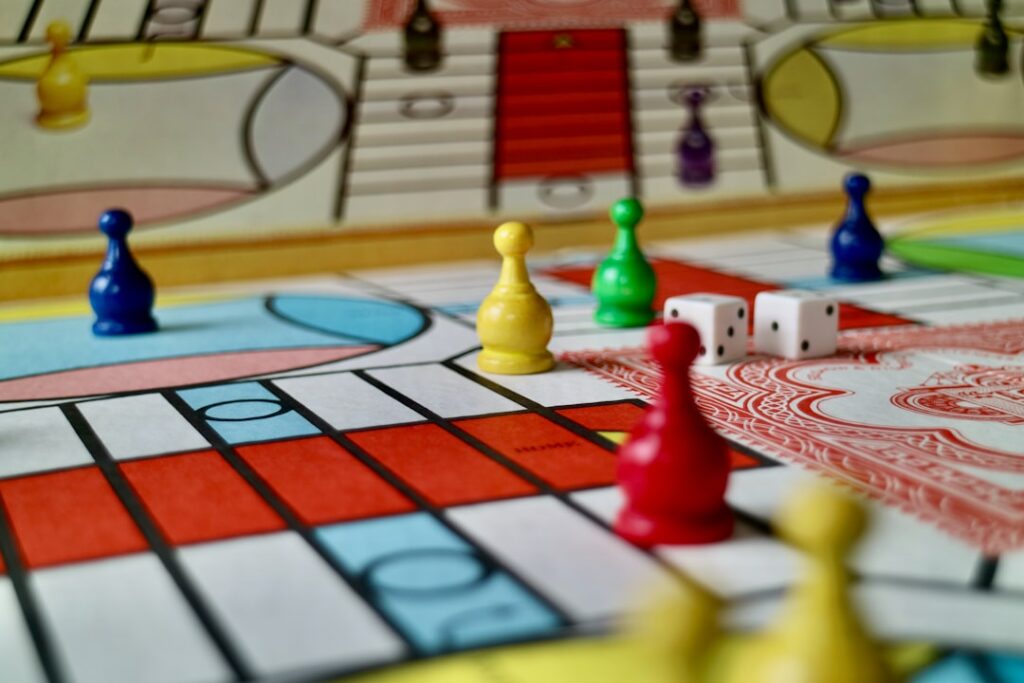
Featured photograph: Nik Korba on Unsplash. Illustrative photograph of an existing Parcheesi game, not an AI-designed prototype.
Updated September 27, 2026. This article was created with AI assistance. For general information; check current product terms and obtain qualified advice where appropriate. Read our disclaimer.


