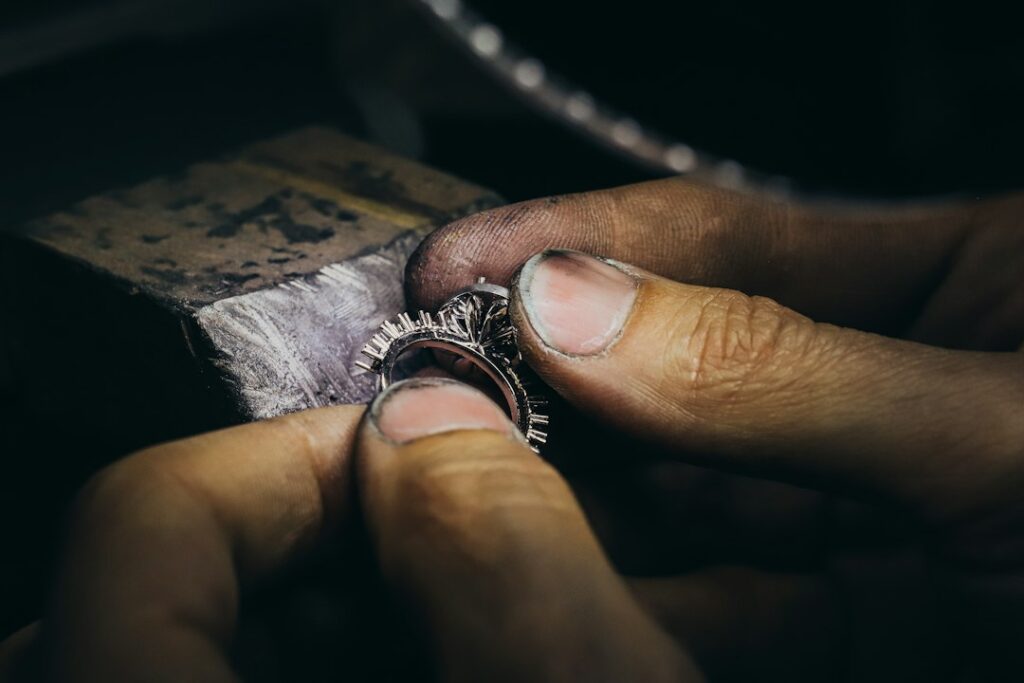
An AI image can help you explain the kind of ring, pendant, or bracelet you have in mind. It may reveal that you like a rounded shape, a matte surface, or a small colored stone. That is a useful starting point for a conversation with a jeweler.
It is not a manufacturing drawing, a gemstone report, or a promise of what a piece will cost. The aim is to turn a visual preference into a brief that someone can evaluate and make.
Describe how the piece will be worn
Start with the everyday requirements before generating images. Is this an occasional piece or something you want to wear daily? Does it need to sit beside an existing ring, fasten easily, or avoid catching on clothing? State any known material sensitivities to the jeweler rather than asking AI to diagnose them.
Include your total budget and whether you hope to reuse a stone or family piece. Do not assume that an existing stone can safely be reset or that old metal is suitable for a particular design. Ask the jeweler to inspect the item and explain the options before anything is altered.
You can explore style without uploading personal photographs. A written description may be sufficient. If you share reference images, choose ones you have permission to use and remove unrelated personal information.
Generate a small number of different ideas
A useful prompt gives direction without pretending that engineering has already been done:
Create three concept images for a simple pendant inspired by leaf shapes. Use a restrained style and show visibly different silhouettes. Label these as concepts only. Do not add a brand logo, invent a gemstone certificate, or claim the designs are ready to manufacture.
Choose one or two features from the results rather than asking for endless variations. Write down what you like in ordinary words: “a softer outline,” “less surface decoration,” or “a smaller center detail.” These statements remain useful if the image contains an impossible connection or an awkward proportion.
Look at the picture closely. A clasp may have no workable opening; a stone may appear unsupported; the front and side views may describe different objects. Ask the jeweler which aspects are feasible rather than asking AI to certify its own design.
Understand the step from an image to a model
Computer-aided design, or CAD, can represent dimensions and relationships that an attractive image does not establish. GIA’s jewelry design and technology program treats concept development, CAD engineering, manufacturing constraints, and physical prototyping as related skills. Rendering a picture is one part of that larger process.
This distinction matters when a service advertises “AI jewelry design.” Ask what you will receive: an illustration, an editable CAD file, a physical prototype, or a finished piece. Ask who checks the design and who is responsible for producing it.
A generated picture should not quietly become your approval of unseen dimensions. Request the measurements and materials in a form you understand. Where practical, discuss a model or sample that helps you judge scale and comfort before final production.
Check the materials and the quotation
A yellow-looking surface in an image does not identify gold content. A bright stone does not establish its identity or quality. The FTC’s consumer guidance on precious-metal jewelry explains why descriptions and markings matter and recommends checking the seller and written return terms.
Ask the jeweler to specify the metal, stone details, dimensions, finish, and work included. Clarify design fees, deposits, revision limits, delivery expectations, resizing, and what happens if you do not approve the proposal. Custom-work policies may differ from those for ready-made items; obtain the actual terms.
Keep the budget discussion separate from the image’s appearance. A subtle change in size, construction, or material can affect the quotation. Do not rely on an AI-generated price as a current offer from a real maker.
A brief you can actually bring to a jeweler
In a fictional example, someone wants a pendant to mark a family milestone. Their brief says: an abstract leaf shape, a smooth finish, no copied logo, a modest overall size to be confirmed in person, and a firm total spending limit. It includes one concept image and labels its decorative details as suggestions.
They ask the jeweler to propose workable construction and explain any changes. The resulting discussion is about a real object and a real quotation, not whether the maker can reproduce every pixel.
If you plan to sell design concepts yourself, describe that service honestly. An illustration service should not imply that you have tested a finished piece or verified a gemstone. AI can widen the range of ideas you bring to the table; skill, clear specifications, and inspection make those ideas wearable.
Updated September 24, 2026. Prepared with AI assistance and checked against the linked sources. Fictional examples illustrate a workflow and are not reports of product testing. See our disclaimer.
Featured photograph: Tahlia Doyle / Unsplash. Shown for illustration, not a product tested or a project completed by this site.


