
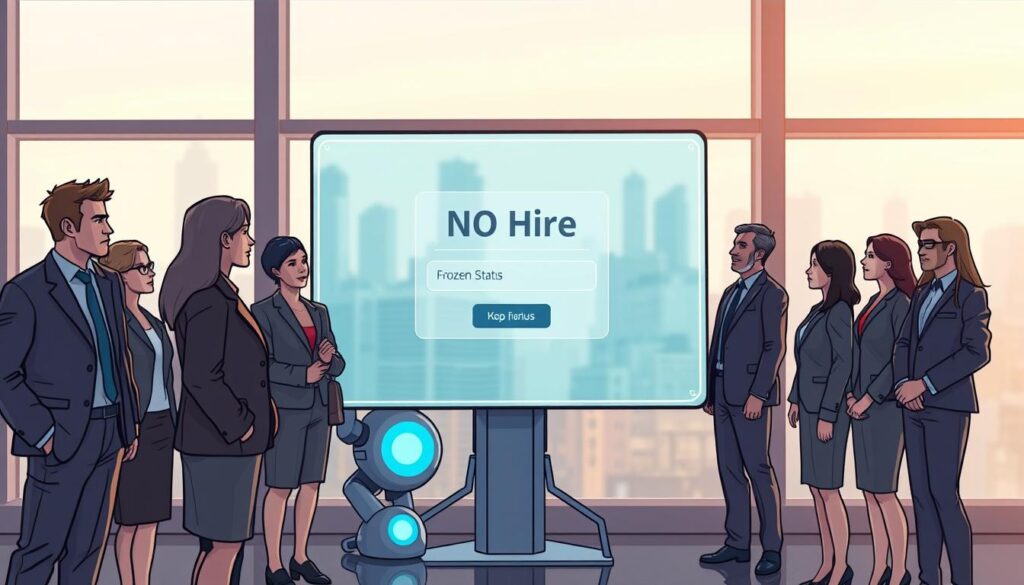
Are you feeling stuck in your job search? It might seem like finding a job is getting tougher, even though the national numbers say things are stable.
Experts say we’re in a no-hire economy. This is because of too much hiring during the pandemic and companies now spending less.
Some think an AI hiring freeze is causing fewer open roles. But, automation in the AI job market isn’t the only reason for this.
We’ll look into how these issues affect your job search. Knowing about these changes can help you move forward with confidence.
The No-Hire Economy: Is AI Freezing Open Roles?
If you’re feeling stuck with no job offers, you’re not alone. The no-hire economy is real. It’s when companies pretend to grow but really aren’t hiring. You might see lots of open roles online, but getting an interview is hard.
Why Companies Keep Posting Jobs Without Hiring
Companies list jobs for reasons other than needing to hire. They might want to see if people are interested or build a talent pool for later. This way, they get lots of resumes without the pressure of hiring right away.
Some firms also list jobs to look good to investors or rivals. Even if they’re not hiring, they want to show they’re growing. This makes it hard to know what’s real and what’s not.
How Economic Uncertainty Encourages Hiring Freezes
When money gets tight, companies get cautious. They might freeze hiring and use AI to do more with less. This means they’re not adding new jobs, even if they seem to be.
This makes it tough to know if a job is real or just a placeholder. Uncertainty means companies wait for better times before hiring. This leaves good candidates stuck in limbo.
Why an Open Job Posting Does Not Guarantee an Active Search
Just because a job is listed doesn’t mean it’s a real opportunity. You need to look beyond the job title. Many things can affect if a company is ready to hire.
Budget approvals, internal candidates, and changing headcount plans
Jobs are often posted before the budget is set. Companies might choose internal candidates over outsiders. If plans change, the job might stay listed even if no one is being hired.
Signs that a listing is stale or no longer a priority
Old job postings can be a sign of trouble. Look at when the job was first listed. If it’s been months with no updates, it might be inactive. Watch if the company keeps reposting the same job. This usually means they’re having trouble finding the right person or have lost interest.
How AI Is Changing the Hiring Pipeline
Before you get an interview, your resume goes through digital filters. The AI job market now focuses on speed, using software to screen you.
Big companies use automated resume screening to handle lots of applications. This tech is the first to decide who gets to see a real person.

Where Employers Use AI Before a Recruiter Reviews Your Application
AI tools are common in fast-paced fields like finance, IT, and marketing. They check your info as soon as you apply.
Even though many are testing AI, the goal is clear: to speed up the hiring process. They want to find the best candidates quicker than before.
How Applicant Tracking Systems Rank Resumes
Today’s applicant tracking systems break down your resume into data points. They look for patterns that match what the employer wants.
These systems give your application a score based on how well it fits the job. A higher score means you’re more likely to get noticed.
Why Automated Screening Can Delay or Eliminate Qualified Candidates
Dependence on automated resume screening can block even the best candidates. If your resume doesn’t match the system’s criteria, you might be missed.
Keyword matching and job-description alignment
Success often hinges on using the right resume keywords from the job posting. If your words don’t match, the system might overlook your skills.
Application volume, duplicate submissions, and screening thresholds
With lots of applications, companies set high standards for AI-powered hiring. If you send in multiple resumes, it might think you’re a duplicate or penalize you for inconsistency.
What AI Can and Cannot Decide About Your Fit
Applicant tracking systems are great at finding technical skills but can’t judge your fit. They can spot resume keywords, but they can’t grasp your drive or career path.
AI can highlight your resume keywords, but it can’t replace human insight. Genuine human judgment is key in deciding if you’re the right fit for the team.
Why Roles Stall After You Apply or Interview
Many candidates face the confusion of a stalled application without receiving a formal rejection. You might feel like you performed well, yet the process suddenly loses momentum. Understanding the hidden mechanics behind these pauses can help you maintain your professional composure.
Hiring Managers May Be Waiting for Business or Budget Approval
Often, the main obstacle is a lack of budget approval. Even if a department head wants to hire you, the finance team may have placed a temporary hold on all new headcount. This delayed hiring process is rarely a reflection of your skills, but a result of shifting corporate priorities.
AI Pilots Can Change the Skills a Team Needs
The rise of AI recruiting tools has changed how teams evaluate talent. If a company launches an AI pilot program mid-search, they may pause hiring to see if automation can handle the workload. This shift often forces managers to redefine the role, making your previous interview performance feel like a moving target.
Internal Restructuring Can Pause an Ongoing Search
Sometimes, a frozen job role occurs because the company is undergoing a major reorganization. Leadership might decide to prioritize internal candidates to fill gaps, effectively closing the door on external applicants without notifying them. This internal movement is a common reason for sudden silence during the final stages of an interview.
How to Distinguish a Normal Delay From a Frozen Role
It is important to recognize the warning signs of a hiring freeze versus a standard administrative delay. While some pauses are temporary, others indicate that the position is no longer viable.
Unclear timelines and repeated changes to the hiring process
If you notice that the interview schedule keeps shifting or the requirements for the role change frequently, the company may be struggling with internal alignment. Unclear timelines are a major red flag that the decision-making process has stalled. When a company cannot provide a firm date for the next step, it often means they are waiting for external factors to resolve.
Recruiter silence after interviews or requested materials
Recruiter silence is perhaps the most frustrating aspect of the modern job search. If you have provided requested work samples and then hear nothing for weeks, the role may have been put on hold indefinitely. Do not take this personally, as it is frequently a symptom of broader organizational instability.
How to Make Your Job Search More Resilient
Creating a resilient job search plan is key to beating a hiring freeze. Instead of applying to many jobs, focus on ones that really need you. This way, you save energy for jobs that might actually lead to a job.
Prioritize Employers With Evidence of Active Hiring
Look at sectors that are growing, like healthcare, government, and skilled trades. These areas usually keep hiring steady, unlike tech or luxury retail.
When you find active hiring companies, check if they’re really hiring. Look for signs they’re expanding their teams, not just pretending to.
Use Recent Job Posts and Employee Updates as Signals
Steer clear of stale job postings that have been up for months. These inactive job listings often mean a job is frozen and won’t be filled soon.
Instead, watch company LinkedIn pages for updates. Celebrations of new products mean they’re hiring for that area.
Build a Pipeline Instead of Relying on One Application
Don’t rely on just one job. A delayed hiring process can surprise you. Apply to many places to keep your options open.
Think of your job search as a sales funnel. This way, you always have chances, even if one doesn’t work out.
Combine Online Applications With Human Connections
Digital apps often favor internal candidates or certain keywords. To stand out, mix online apps with personal connections.
Request targeted referrals from former colleagues and professional contacts
Personal recommendations are powerful. Ask your network for targeted referrals to show your skills directly to the hiring manager.
Contact recruiters with a concise, role-specific message
When contacting recruiters, be brief and clear about your value. A concise, role-specific message shows you respect their time and know the job well.
Track Applications, Follow-Ups, and Hiring Signals
Keep a detailed spreadsheet of your interactions and application status. This helps you see which companies are really hiring.
Set reminders to follow up on your applications after a week or two. Regular, professional follow-ups can help you find better opportunities.
How to Strengthen Your Resume and Interview Position
Today’s job market is tough. You need a smart plan to stand out. Improve how you show your skills to beat the competition.
Customize Your Resume for Human and Automated Review
Make your resume work for both automated resume screening and human eyes. Use the right resume keywords to get noticed by applicant tracking systems.
Match the employer’s language without copying the job description
Look at the job posting for key themes and terms. Use these in your resume to show you fit the job. Don’t just copy the job description to keep your resume fresh and personal.
Show measurable outcomes, scope, and relevant tools
Show off your achievements with numbers, like how much you’ve grown revenue or saved time. List the tools you’ve used to get these results. This proves you can do the job.
Make Your LinkedIn Profile Support Your Target Role
Your LinkedIn profile is like an online resume. Make sure it shows you’re looking for the right job. Get targeted referrals to skip the long application lines.
Prepare Examples That Prove You Can Deliver Results
In interviews, tell stories of your success. Focus on times when your work made a big difference.
Explain how you used technology to improve productivity or decisions
Talk about how you used tech to make things better. Share your thought process and the good results you got. This shows you’re tech-savvy.
Describe judgment, collaboration, and problem-solving that AI cannot replace
Show off your AI-resistant skills by talking about complex teamwork and tough decisions. These skills are key for leadership roles.
Ask Interview Questions That Reveal the Role’s Status
Ask smart interview questions to check if the job is real. This helps you know if the company is serious about hiring.
Confirm the hiring timeline, decision maker, and business reason for the position
Ask about the budget approval to make sure the job is funded. Find out who will decide and when. This saves you from wasting time on uncertain jobs.
Ask whether the responsibilities or team structure have changed
Check if the team’s goals have changed. Knowing if the job has evolved helps you see if you’re a good fit. Stay informed to focus on real opportunities.
Conclusion
The modern workplace is changing, and so are job opportunities. The no-hire economy is not a complete end to jobs. It’s a time of change in the AI job market.
AI tools help companies find talent, but they’re not perfect. Showing skills like judgment, creativity, and teamwork makes you stand out. These skills are key for big companies like Microsoft and Google.
Looking for a job is more than just applying. It’s about making connections and checking if jobs are really open. Ask the right questions during interviews to find out.
Stay valuable in a changing job market. Mix your tech skills with your human strengths. This way, you’ll grow your career even as things change.